
Flying Ants or Termites? How to Tell What Is Really Swarming Your Texas Home
Keypoints:
- Flying ants and termite swarmers are both winged reproductive insects released during a mating flight, and they are triggered by nearly identical weather.
- The fastest way to tell them apart is three details: wing length, waist shape, and antennae.
- Where you find them matters almost as much as what they look like. Indoors is a bigger deal than outdoors.
- A swarm you can kill is gone in an hour. The colony it came from is not.
- When in doubt, a sample in a sealed bag tells a technician more than a phone description ever will.
Introduction
You flip on the porch light one warm, humid evening, and there they are. A cloud of winged insects swirling around it. Or maybe it is the next morning, and what you find instead is a scattering of tiny discarded wings on the windowsill.
Either way, the first question is not what species this is. It is: do I need to panic?
That question has a clean answer, and it comes down to two very different possibilities. One is flying ants, a short-lived nuisance that is gone by morning. The other is termite swarmers, a visible sign that a colony is already established somewhere close by. You do not need an entomology degree to tell them apart. You just need to know where to look.
Why This Mix-Up Happens
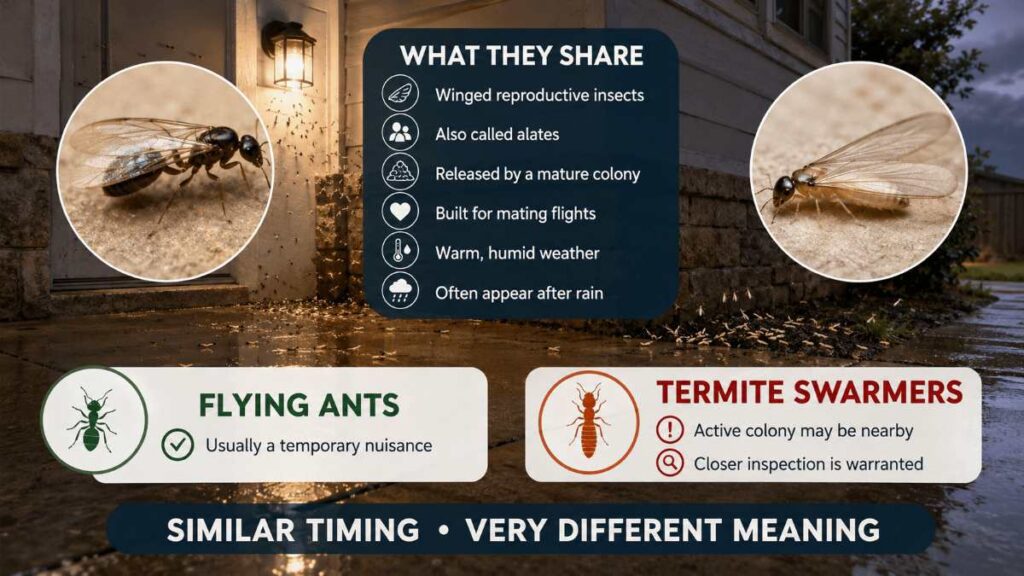
Flying ants and termite swarmers, sometimes called winged termites, are both winged reproductive insects, known as alates, released by a mature colony during a mating flight. Both tend to time that flight around the same kind of weather: warm, humid, often right after rain.
That overlap in timing is not a coincidence, and it is exactly why so many homeowners end up staring at a swarm with no idea which one they are looking at.
The outcomes, though, are not close to the same. A flying ant swarm is a temporary annoyance and nothing more. A termite swarm means an active colony is nearby, and termites do not send up another warning sign until real damage is already underway. One of these is worth a shrug. The other is worth a closer look, and probably a phone call.
Knowing why the confusion happens is one thing. Knowing what each insect actually is, and where it comes from, makes the difference much easier to spot.
Where Flying Ants and Termite Swarmers Actually Come From
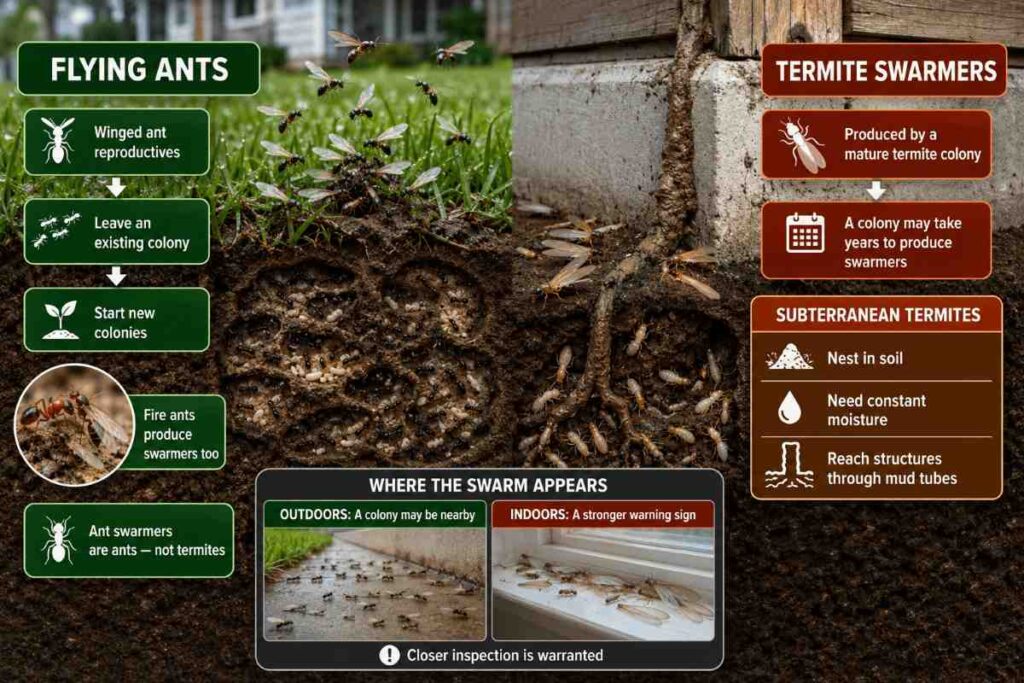
Flying ants are not their own species. They are winged reproductives, sometimes called ant swarmers, that leave an existing ant colony to start new colonies of their own, not to move into your walls. If you have already read our guide on fire ants, you know fire ants produce their own winged reproductives too, so a swarm you write off as just ants could specifically be fire ants taking flight. Either way, the test in the next section still applies, since fire ants are still ants, not termites.
Termite swarmers come from the same basic process, just on the termite side. According to Texas A&M AgriLife Extension, a termite colony typically needs several years to mature before it is capable of producing swarmers at all, which is part of why a swarm is such a meaningful signal rather than a random event.
Most Texas infestations trace back to subterranean termites specifically. These termites live and nest in soil, need constant contact with moisture, and travel into structures through narrow mud tubes rather than living inside wood the way some other termite species do. That is also why a termite swarm indoors carries more weight than one outdoors. It usually means the colony is already inside the structure, or close enough that swarmers are finding their way in on their own.
The Wing, Waist, and Antenna Test
Once you are looking at the insect itself, three details settle the question.
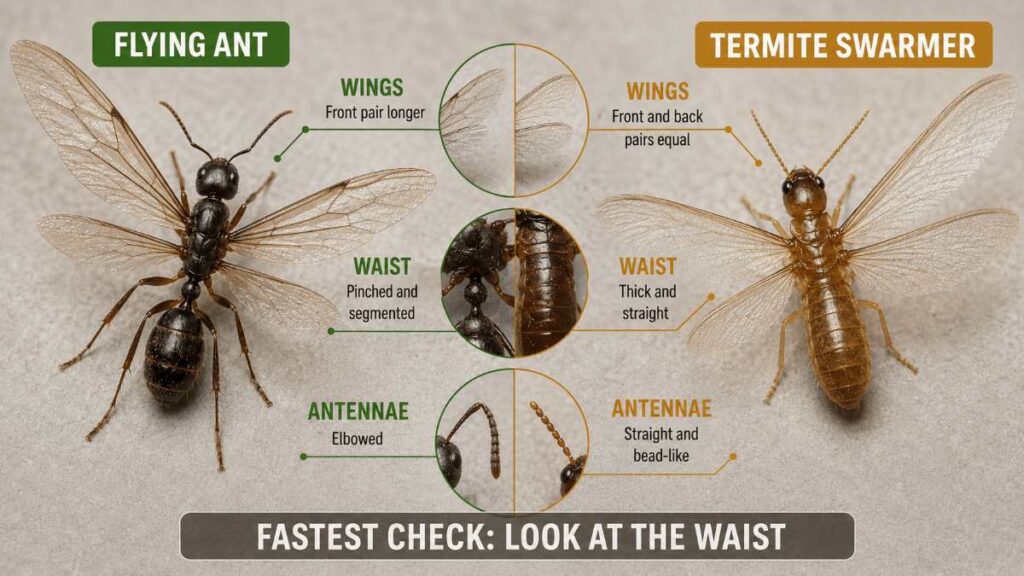
Wings. Ants have two pairs, but the front pair is noticeably longer than the back pair. Termites have two pairs that match, front and back.
Waist. Ants have a pinched, segmented waist, the same narrow hourglass shape you would expect from any ant. Termites have a thick, straight waist with no pinch anywhere along it.
Antennae. Ant antennae bend, almost like a small elbow. Termite antennae run straight, more like a tiny strand of beads.
If you only remember one of these, make it the waist. It is usually the easiest to catch at a glance, even on something small and quick-moving, and you do not need to get close enough to count wing pairs to see it.
Location Tells You Almost as Much as Looks Do
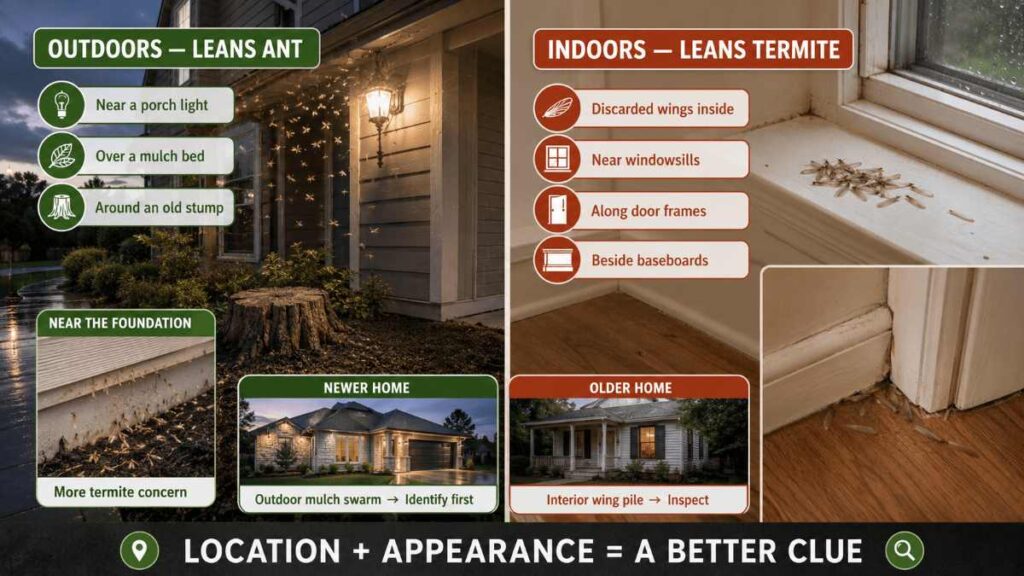
Most people never get a clean, close look at a swarming insect in real time, which is exactly why where you find it matters just as much as what it looks like. A swarm outside near a porch light, a mulch bed, or an old stump usually points toward ants. Discarded wings inside the house point much more strongly toward termites.
Three signs lean toward termites rather than ants. First, wings or insects found indoors rather than outside. Second, discarded wings near windowsills, door frames, or baseboards. Third, a swarm that seems to start near the foundation rather than out in the yard.
Consider an older home in Alamo Heights, where a small pile of wings on an interior windowsill looked at first like leftover moth activity. An inspection found an active termite colony that had not yet caused visible damage, caught early enough to treat before it became a repair bill instead of a routine pest control visit.
Compare that to a newer home in a Cibolo neighborhood, where a swarm near a fresh mulch bed one evening looked alarming at first. A closer look at the wings confirmed ordinary ants, nothing to treat beyond keeping an eye on the mulch going forward.
What to Do If You Find Wings Inside Your Home
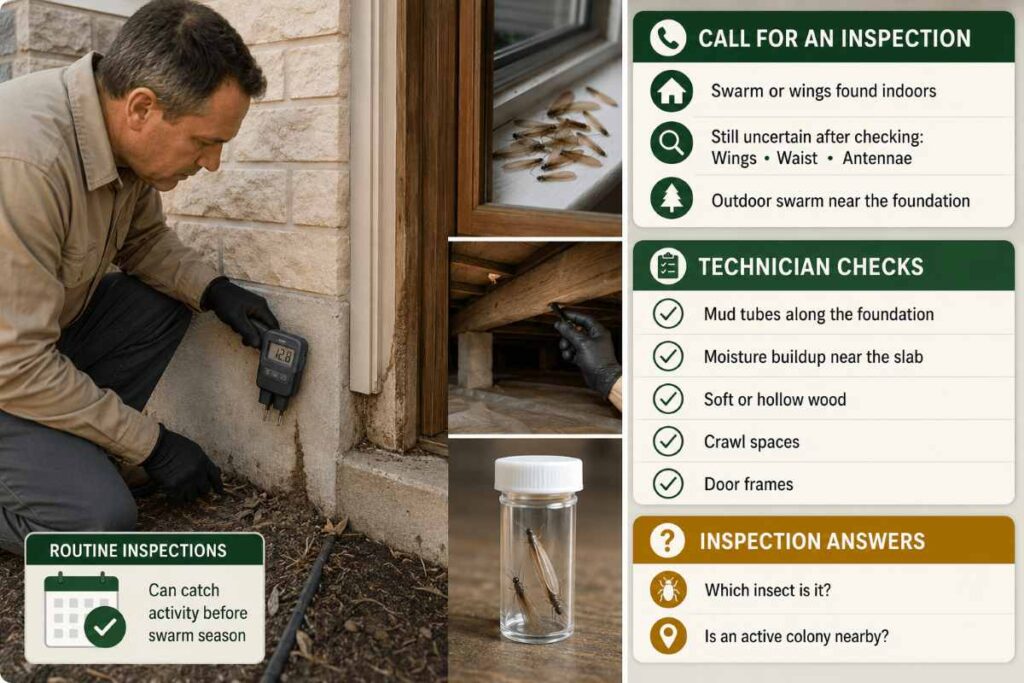
If you come across wings or live insects indoors, resist the urge to vacuum everything up and move on. Collect a few instead, wings included, in a sealed bag or jar. A technician can usually identify the species from an actual sample far more reliably than from a description over the phone, and it saves you a second visit if the first read is uncertain.
Even if you do not see a single insect, just a scattering of shed wings, take it seriously anyway. Wings without any insects nearby usually mean a swarm already happened and moved on, not that the risk did too.
Once you have a sample set aside, the next decision is simple: handle it yourself, or bring in someone who deals with this every day.
When to Call a Professional
A few situations are worth a call no matter how confident you feel about your own identification: any swarm or wings found indoors, real uncertainty after checking wings, waist, and antennae, or an outdoor swarm that seems to be coming from near the foundation rather than out in the yard.
Texas Beeline technicians hear a version of the same question on almost every termite inspection call: which one is this, and does it matter now? A proper inspection answers both. Beyond identifying the sample itself, a technician checks for mud tubes along the foundation, moisture buildup near the slab, and soft or hollow wood in crawl spaces and door frames- signs that confirm or rule out an active colony rather than just the swarm that got someone’s attention in the first place.
If you would rather not wait around for swarm season to force the issue, routine termite inspections catch colony activity long before it ever produces one.
Conclusion and CTA
The wing, waist, and antenna test takes less time to run than it does to read about, and it is the fastest way to know whether you are looking at a nuisance or a warning sign. Ants leave to start new colonies elsewhere. Termites leave because the colony behind them is already established, and possibly already active in or near your home.
When the answer is not obvious, do not guess. Texas Beeline can settle the question with a straightforward termite inspection and catch a problem while it is still small enough to be a quick fix instead of a repair bill. Call or request an inspection with Texas Beeline today to find out for certain what is swarming around your home.
Avoid Costly Pest Control Mistakes!
Don’t let DIY errors cost you more in the long run! Beeline Pest Control of Texas provides expert inspections and science-based solutions to correct common pest control mistakes to avoid. Protect your San Antonio home with a customized plan that gets rid of pests for good!
No Hidden Charges
Frequently Asked Questions
Do flying ants bite?
Rarely, and not aggressively. Flying ants are focused on mating and dispersing, not defending territory, so an encounter with a swarm is unpleasant more than dangerous.
How long does a swarm typically last?
Often less than an hour, sometimes just a few minutes. That is part of why so many homeowners miss the swarm itself and only find the discarded wings afterward.
Does seeing termite swarmers mean my house already has damage?
Not necessarily, but it does mean an active colony is close enough to be a real concern. Catching it at the swarming stage, before any visible damage, is actually the best-case scenario.
Will killing the swarm solve the problem?
No. The swarm is a symptom of the colony, not the colony itself, so getting rid of the visible insects does nothing to address what produced them.
Do termites swarm at night or during the day?
It depends on the species, but many swarms happen in the evening, often near light sources, which is why porch lights are such a common place to notice them.
Does every termite colony swarm every year?
No. A colony typically needs several years to mature before it produces swarmers at all, and even mature colonies do not necessarily swarm every single year.
Are termite swarmers seasonal in Texas?
Swarming activity tends to cluster around warm, humid stretches, often following rain, rather than one fixed calendar date. Exact timing varies by species and by year.
Can I tell the difference just by color?
Not reliably. Both flying ants and termite swarmers range from light brown to black depending on species, so color alone is not a dependable identifier.
Should I keep the wings or insects I found?
Yes, ideally in a sealed bag or jar rather than loose. A physical sample gives a technician far more to work with than a description alone.
How soon after finding a swarm should I get an inspection?
As soon as reasonably possible, especially if the swarm or wings turned up indoors. There is no real downside to an inspection that confirms ordinary ants, but there is a real cost to waiting on one that turns out to be termites.