
Do Ants Have Cerci? The Texas Property Owner’s Guide to Ant Anatomy and Infestation Control
Keypoints:
- Anatomy Distinction: Ants do not have cerci; observing rear appendages can help you distinguish ants from pests like roaches or earwigs.
- Texas Climate Pressure: Intense heat and sudden heavy rain drive aggressive Texas ant species indoors looking for food and shelter.
- Professional Advantage: DIY ant treatments often scatter colonies; customized quarterly pest management provides guaranteed, safe, and long-term elimination.
- Scientific Precision: Texas is home to over 291 species of ants, and understanding the difference between an ant bite and a venomous sting is crucial for proper care.
Introduction: The Hidden World of Texas Ants and Your Property
Owning a home or running a business in the Lone Star State comes with plenty of pride – and its fair share of pest pressures. When the intense Texas heat spikes or sudden downpours flood the soil, millions of tiny insects start looking for higher, drier ground. More often than not, that ground is your kitchen counter, your backyard patio, or your restaurant’s pantry.
Why Identification Matters
Understanding what you are dealing with is the first step in protecting your property. Property owners frequently find themselves squinting at tiny trailing insects, trying to figure out if they are looking at harmless outdoor foragers, destructive wood-boring pests, or aggressive biting invaders.
To accurately identify these intruders and keep your environment safe, relying on professional pest control services Texas property owners trust is essential. At Texas Beeline, we combine local expertise with family-safe methods to safeguard your household peace of mind and protect your hard-earned commercial reputation.
Understanding the Threat: Why the Texas Climate Welcomes Ants
Climate Challenges
Texas weather is notoriously unpredictable. Severe droughts bake the clay foundations of our buildings, causing small cracks to open up. When the weather transitions into heavy downpours, subterranean pest colonies are flooded out of their natural habitats.
Property Vulnerabilities
This dramatic shift creates an immediate migration toward residential slab foundations and commercial loading docks.
The Cost of an Infestation
- For a Homeowner: An ant invasion is an unsettling nuisance that can lead to contaminated food, painful stings for children and pets, and potential structural issues.
- For a Business Owner: Especially in the food service, hospitality, or warehousing sectors, an unmanaged ant problem can result in failed health inspections, ruined inventory, and devastating blows to your public reputation.
Tip: According to the Texas A&M AgriLife Extension Service, Texas is officially home to over 291 species of ants, ranging from minor structural nuisances to aggressive, venomous health hazards.
Do Ants Have Cerci? Cracking the Code of Ant Anatomy
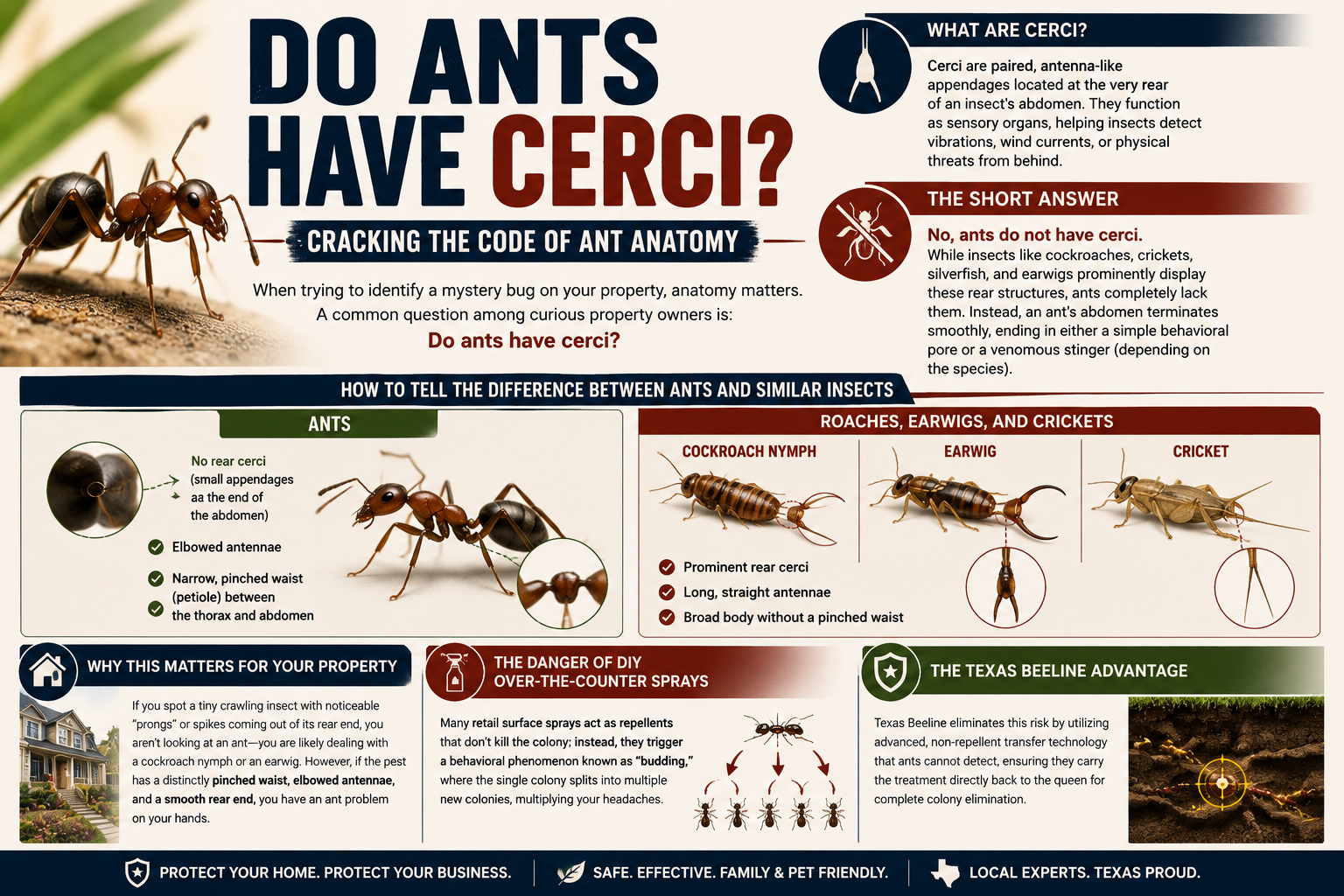
When trying to identify a mystery bug on your property, anatomy matters. A common question among curious property owners is: Do ants have cerci? What Are Cerci?
Cerci are paired, antenna-like appendages located at the very rear of an insect’s abdomen. They function as sensory organs, helping insects detect vibrations, wind currents, or physical threats from behind.
The Short Answer
No, ants do not have cerci. While insects like cockroaches, crickets, silverfish, and earwigs prominently display these rear structures, ants completely lack them. Instead, an ant’s abdomen terminates smoothly, ending in either a simple behavioral pore or a venomous stinger (depending on the species).
How to Tell the Difference Between Ants and Similar Insects
Ants
- No rear cerci (small appendages at the end of the abdomen)
- Elbowed antennae
- Narrow, pinched waist (petiole) between the thorax and abdomen
Roaches, Earwigs, and Crickets
- Prominent rear cerci
- Long, straight antennae
- Broad body without a pinched waist vb
Why This Matters for Your Property
If you spot a tiny crawling insect with noticeable “prongs” or spikes coming out of its rear end, you aren’t looking at an ant—you are likely dealing with a cockroach nymph or an earwig. However, if the pest has a distinctly pinched waist, elbowed antennae, and a smooth rear end, you have an ant problem on your hands.
The Danger of DIY Over-the-Counter Sprays
Many retail surface sprays act as repellents that don’t kill the colony; instead, they trigger a behavioral phenomenon known as “budding,” where the single colony splits into multiple new colonies, multiplying your headaches.
Texas Beeline eliminates this risk by utilizing advanced, non-repellent transfer technology that ants cannot detect, ensuring they carry the treatment directly back to the queen for complete colony elimination.
Beyond Anatomy: Managing the Broader Texas Pest Picture
To keep a property genuinely pest-free, looking at individual insects isn’t enough; you have to look at the big picture. Texas property owners must navigate a gauntlet of pests year-round, making a reactive, one-time treatment approach ineffective.
General vs. Specialized Pest Control
A general pest treatment might clear away visible foragers on your kitchen counter, but specialized threats require targeted expertise. For instance, subterranean termites require deep soil barriers, while aggressive scorpions require specialized exterior dusting and micro-cap treatments.
The Value of Eco-Friendly, Year-Round Management
Modern pest defense relies on sustainability. By utilizing eco-friendly pest control practices, professional teams target the specific biology of the pest without broadcasting harsh chemicals across your living spaces. Implementing a routine quarterly pest management strategy ensures that seasonal shifts are met with proactive defensive barriers, intercepting pests outside before they ever find a way into your home or business.
DIY vs. Expert Protection with Texas Beeline
It is tempting to grab a can of bug spray or a bag of bait from a big-box store. However, residential homes with complex weep holes and slab foundations, as well as commercial properties with sprawling inventory areas, possess thousands of hidden entry points that DIY methods simply cannot protect.
The Professional Difference
Professionals possess specialized diagnostic equipment, intensive biological training, and access to commercial-grade materials that are safer and more effective than retail alternatives.
“Texas ants are incredibly resilient. When property owners use DIY retail sprays, they usually only eliminate the 5% of the colony that is foraging. The remaining 95% stays hidden deep in the walls or underground, reproducing rapidly. True control requires tracking the trails back to the source and neutralizing the nest.”
— Texas Beeline Licensed Technician
By trusting local experts, you protect your family, pets, and customers from improper chemical applications while securing a long-term, stress-free warranty on your property’s health.
The Texas Beeline Property Protection Strategy
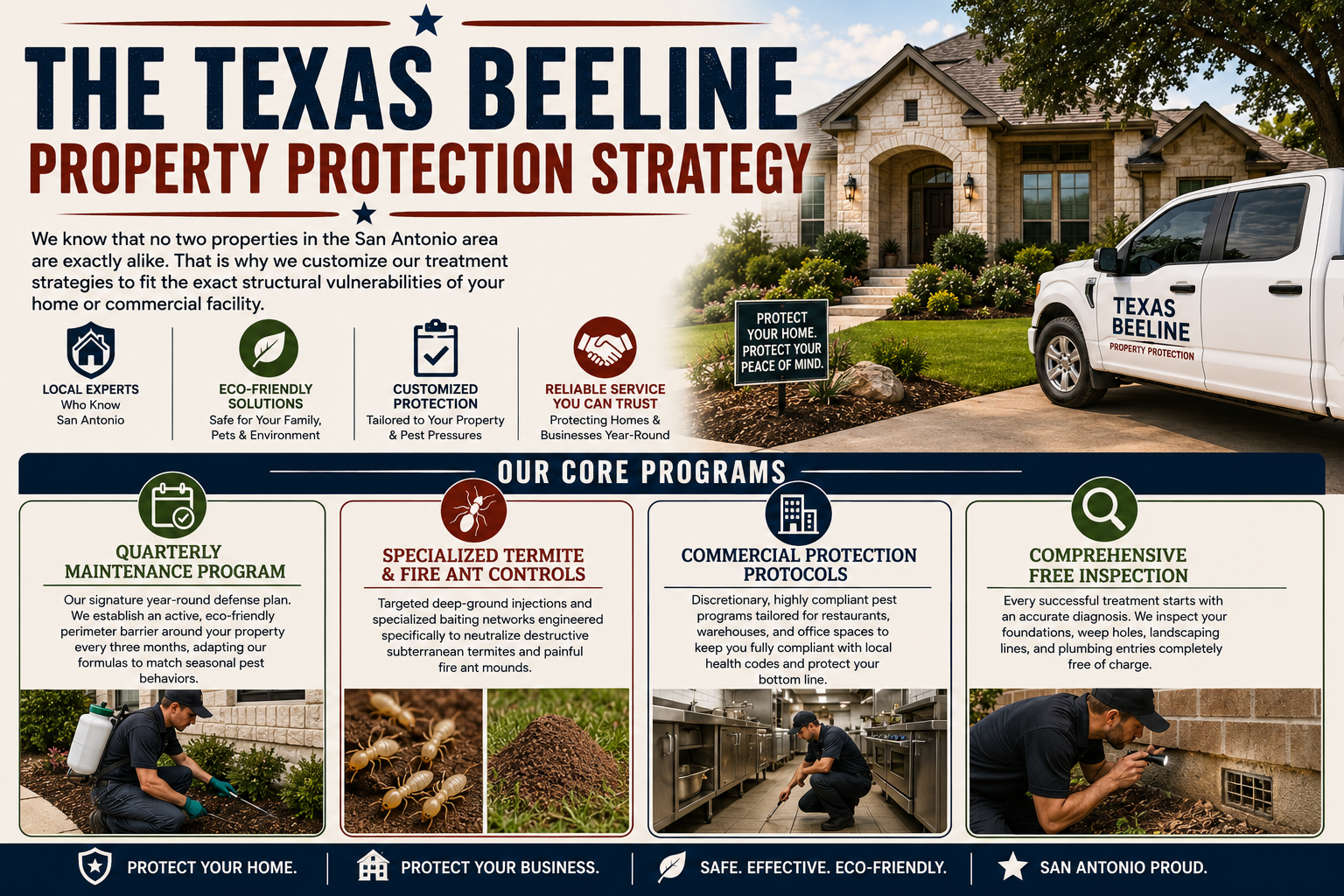
We know that no two properties in the San Antonio area are exactly alike. That is why we customize our treatment strategies to fit the exact structural vulnerabilities of your home or commercial facility.
Our Core Programs
- Quarterly Maintenance Program: Our signature year-round defense plan. We establish an active, eco-friendly perimeter barrier around your property every three months, adapting our formulas to match seasonal pest behaviors.
- Specialized Termite and Fire Ant Controls: Targeted deep-ground injections and specialized baiting networks engineered specifically to neutralize destructive subterranean termites and painful fire ant mounds.
- Commercial Protection Protocols: Discretionary, highly compliant pest programs tailored for restaurants, warehouses, and office spaces to keep you fully compliant with local health codes and protect your bottom line.
- Comprehensive Free Inspection: Every successful treatment starts with an accurate diagnosis. We inspect your foundations, weep holes, landscaping lines, and plumbing entries completely free of charge.
Safety and Compliance Assurance for All Properties
Frequently Asked Safety Question
- Question: Are your treatments safe for my children, pets, or business clients?
- Answer: Yes, absolutely. At Texas Beeline, family safety and business compliance are our top priorities. We strictly utilize EPA-approved, low-toxicity, and eco-friendly products applied precisely where pests hide, keeping them completely out of reach of your children, domestic pets, and patrons.
Proactive Tips for a Pest-Free Environment
While our technicians provide the heavy-duty defensive barriers, establishing clean daily habits can significantly lower pest pressure on your property.
For Homeowners
- Clear the Weep Holes: Insert specialized mesh covers into the weep holes along your brick exterior to block easy insect entryways without trapping damaging moisture inside your walls.
- Trim the Greenery: Keep tree branches, ornamental bushes, and thick mulch beds at least 12 to 18 inches away from your foundation to eliminate natural pest bridges.
- Manage Moisture: Repair leaking outdoor spigots, clear out clogged roof gutters, and ensure your HVAC condensation lines drain well away from the house.
For Business Owners
- Audit Loading Docks: Inspect rubber dock seals and door sweeps regularly; if light shines through the bottom of a closed door, ants and rodents can easily slip inside.
- Optimize Trash Management: Situate large commercial dumpsters on concrete pads away from main entrance doors and ensure lids remain tightly sealed.
- Rotate Inventory: Practice strict “First-In, First-Out” (FIFO) inventory protocols in storage rooms to prevent pests from nesting undisturbed in old cardboard boxes.
Conclusion: Claim Your Peace of Mind Today
Don’t let Texas pests claim your property or reputation. Contact Texas Beeline today for a free inspection and customized, guaranteed protection. Whether you are dealing with hidden ant colonies, invading scorpions, or looking to establish a long-term preventative shield, our experienced local team is ready to step in.
Key Reminder: We proudly provide premium residential and commercial pest control services in San Antonio, Universal City, Converse, Castle Hills, Alamo Heights, Cibolo, and other surrounding areas in Texas. To find out more about our residential pest control services and commercial pest control services, click the links or visit our Contact Us page to fill out our form, or call our local team directly today at 210-739-1320.
Avoid Costly Pest Control Mistakes!
Don’t let DIY errors cost you more in the long run! Beeline Pest Control of Texas provides expert inspections and science-based solutions to correct common pest control mistakes to avoid. Protect your San Antonio home with a customized plan that gets rid of pests for good!
No Hidden Charges
Frequently Asked Questions
Do ants have cerci?
No, ants do not have cerci. Cerci are paired sensory appendages found on the rear abdomen of insects like cockroaches and earwigs, whereas an ant’s abdomen terminates smoothly.
How to find or track ants?
To track ants, look for active trailing lines along structural edges like baseboards, sidewalk cracks, or electrical wires, especially after dark or following a rainstorm. You can trace these lines backward toward their entry points or place small dabs of honey or jelly to encourage them to reveal their hidden nesting paths.
How to identify ants?
Ants can be identified by their distinctly pinched three-segment bodies, elbowed antennae, and a lack of rear cerci. For exact species identification, a professional look at their size, coloring, and node count under a magnifying lens is required.
What are the common ant species in Texas (tiny/crazy ants, big ants, little black ants)?
Common Texas varieties include aggressive Red Imported Fire Ants, destructive Carpenter Ants (big ants), invasive Rasberry Crazy Ants (tiny/crazy ants), and Little Black Ants. Each species exhibits unique nesting preferences and food cravings, which require customized professional treatment approaches.
What does a Texas ant bite look like?
While ants use their mandibles to bite and anchor themselves, a fire ant delivers a venomous sting that develops into a small, painful red bump, which quickly forms a distinct white, fluid-filled pustule within 24 hours. These stings often occur in clusters, causing localized itching, swelling, and burning sensations.
Are the pest treatments safe for my children, pets, or restaurant customers?
Yes, Texas Beeline uses highly targeted, eco-friendly products that are strictly EPA-approved and applied safely around loved ones and customers. Our modern application techniques place treatments precisely where pests travel, keeping them well away from human and pet contact.
How often should I schedule pest control services for a home versus a commercial facility?
Residential properties generally maintain excellent pest-free defense with a routine quarterly pest management plan. Commercial properties, particularly food service or medical facilities, usually require more frequent monthly or bi-weekly treatments to comply with strict local health codes.
What are the first signs of a termite infestation?
Early warning signs of termites include the presence of fragile mud tubes climbing up your concrete foundation, discarded translucent insect wings on windowsills, and hollow-sounding wood trim. If you spot any of these indicators, you should contact Texas Beeline immediately to schedule a comprehensive termite evaluation.
Why do I see more pests when it rains?
Heavy rain saturates the outdoor soil, flooding subterranean insect nests and forcing pests out of their natural habitats. Seeking dry ground, warmth, and reliable food sources, these dislodged pests quickly migrate through small foundation cracks and weep holes into your property.
Can I do effective pest control myself?
While DIY retail options can kill a few visible pests on contact, they rarely reach the hidden core of a mature colony and can cause species like ants to scatter further inside your walls. Professional treatments utilize commercial-grade, non-repellent transfer materials that target the root of the colony safely and permanently.
What is the difference between a one-time treatment and a quarterly plan?
A one-time treatment only addresses the active adult pests visible on your property at that specific moment. A quarterly plan builds a continuous, proactive defensive barrier around your structure that changes with seasonal pest life cycles to stop infestations before they ever start.
How long does it take to eliminate a roach or ant infestation?
While you will notice an immediate drop in pest activity within the first 24 to 48 hours of a professional Texas Beeline service, completely neutralizing a complex, well-established colony or nest typically takes anywhere from 7 to 21 days.