
What Actually Happens When a Beeline Technician Comes to Your House

Keypoints:
- A professional pest control visit involves more than spraying and leaving.
- A thorough inspection identifies the conditions actually causing a pest problem, not just the bugs visible on the surface. Licensed, trained technicians and a real walkthrough matter even more in a climate like Texas, where pest pressure runs year-round.
- Most homeowners can help their technician get better results by pointing out specific problem areas, and a single visit doesn’t always resolve every issue, which is normal for larger or ongoing problems.
Introduction
Picture this. Someone in a uniform shows up, sprays along your baseboards for five minutes, hands you a receipt, and leaves before you’ve had a chance to ask a single question. If that’s what comes to mind when you think about a pest control visit, you’re not imagining things. That experience is common enough in this industry that it has earned pest control a reputation it doesn’t have to live with.
Here’s what actually happens when a Texas Beeline technician comes to your home, from the first phone call to what happens if the problem needs a second look. In a state where pests are active most of the year, a rushed five-minute visit rarely holds up. What follows is the process that does.
How Do I Schedule a Pest Control Visit, and What Should I Do Beforehand
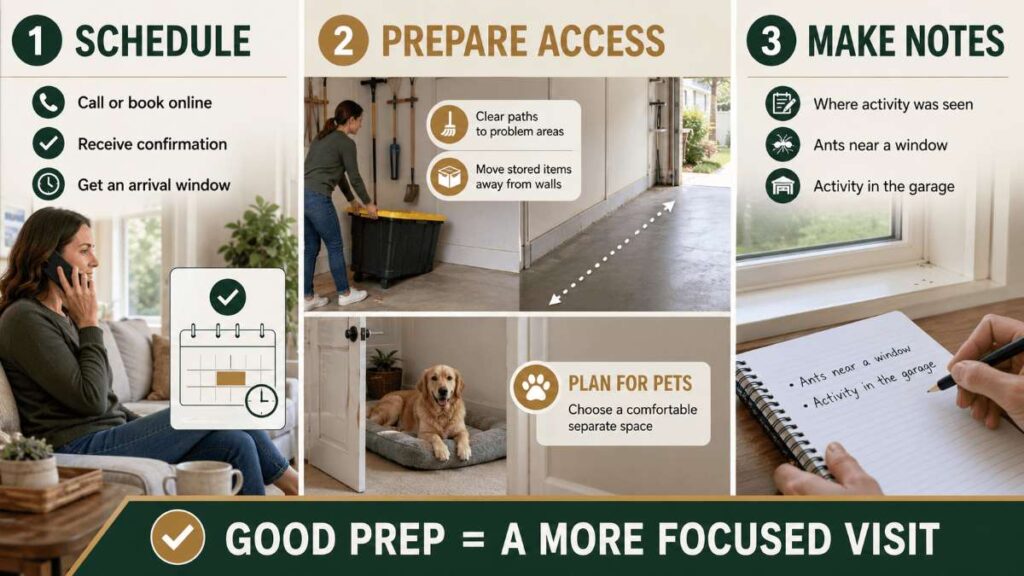
Scheduling is simple, whether you call or book online, and you’ll get a confirmation with a window of time for the visit. A little prep beforehand goes a long way. Clear reasonable access to any problem areas, maybe move a stored box away from the wall where you’ve spotted activity, and find somewhere comfortable for pets to hang out during the visit. If you’ve noticed ants near a specific window or activity out in the garage, jot it down so it doesn’t slip your mind later.
What Happens When the Technician First Arrives
Expect a technician in uniform, ready to introduce themselves and walk you through what the visit involves. Texas Beeline technicians are licensed and trained specifically for the pests common to this region, so this is also a good moment to mention anything specific you’ve noticed, along with any pets, kids, or health considerations in the home. A good visit starts with a conversation, not a spray bottle.
What Does a Pest Control Inspection Actually Involve
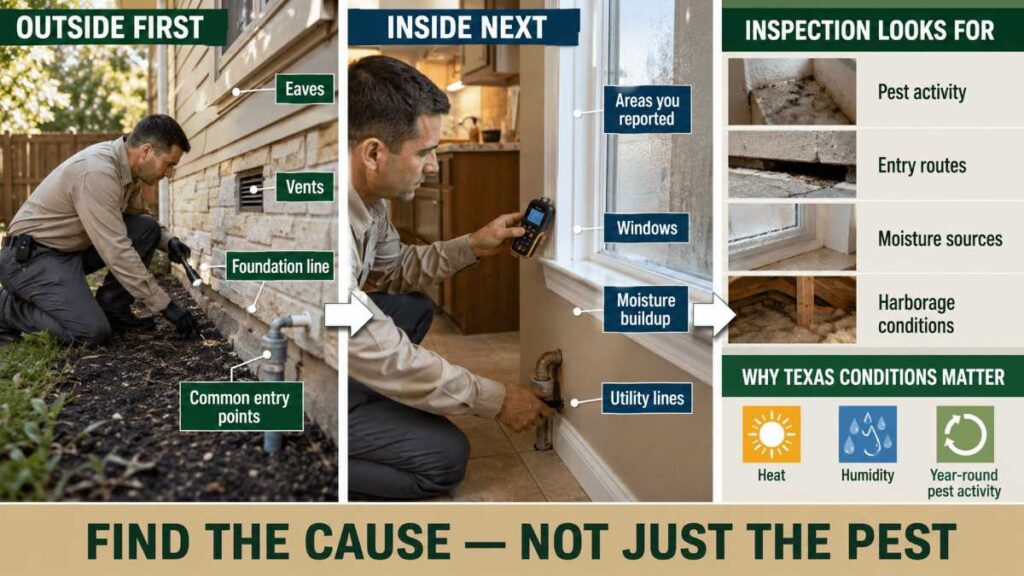
This is where the real work happens, and it’s also where a genuine inspection separates itself from a quick walkthrough. It starts outside. The foundation line, eaves, vents, and other common entry points get checked first. From there, the technician moves indoors, focusing on whatever you flagged plus anything they notice along the way, like moisture building up near a window or a gap around a utility line.
An inspection isn’t just about spotting bugs. It’s about figuring out what’s letting them in or keeping them around in the first place, which matters more here than in milder climates, since Texas-specific climate, heat, and humidity give pests far more opportunities to move in and stay active year-round.
What Does Pest Control Treatment Actually Look Like
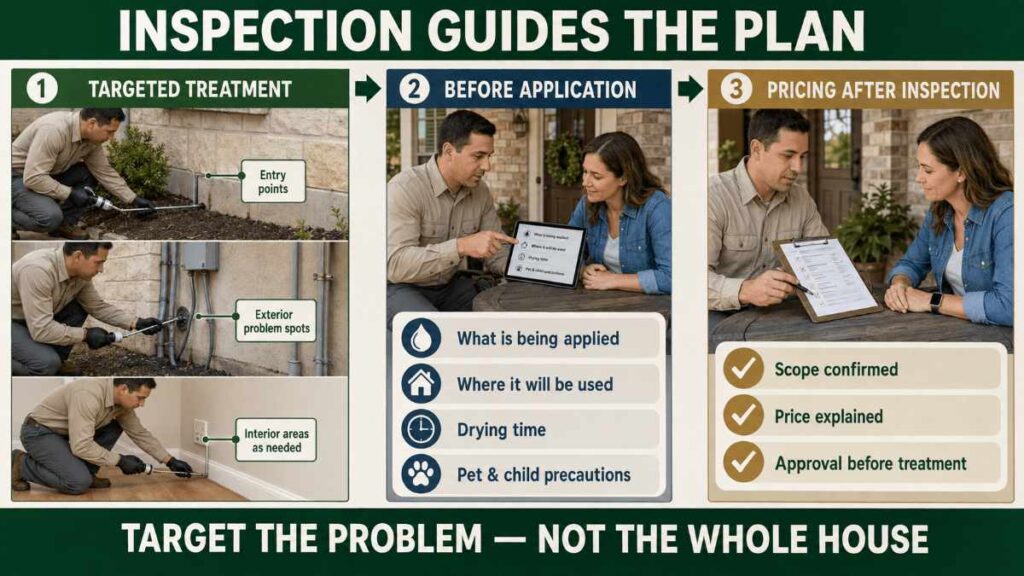
Treatment follows whatever the inspection turns up, not a blanket application across the entire house. That could mean targeted work around specific entry points and problem spots outside, paired with interior treatment limited to where it’s actually needed.
Your technician will walk you through exactly what’s being applied, where, and any guidance on drying time or keeping pets and kids away from treated areas for a bit. Pricing is typically discussed after the inspection, once your technician knows the scope of the problem, so you know what you’re agreeing to before any treatment begins.
How Long Does a Pest Control Visit Take
A thorough visit takes real time, and that’s by design. Skipping steps to move faster is exactly how conducive conditions get missed, and it’s often why a problem resurfaces just weeks after a rushed treatment. A visit built around an actual inspection naturally runs longer than a five-minute spray, and that extra time is what solves the problem instead of just covering it up for a little while.
What Happens After the Technician Leaves
By the time the visit wraps up, you should know exactly what was found, what was treated, and what comes next, including any drying time before pets or kids head back into treated areas. Texas Beeline stands behind its work, so if something isn’t resolved, the next step is simple: reach back out instead of waiting around and hoping it improves on its own.
What if Pests Come Back After One Visit
Not every pest problem wraps up in a single visit, especially with larger infestations or ones that have had time to take hold. That’s not a failure; it’s just how pest control sometimes goes, and a technician who tells you that upfront is more trustworthy than one who promises a guaranteed fix on the first try. Follow-up visits are a normal part of handling tougher cases, and Texas Beeline treats them exactly like the first appointment, with another full inspection rather than a quick touch-up.
Examples
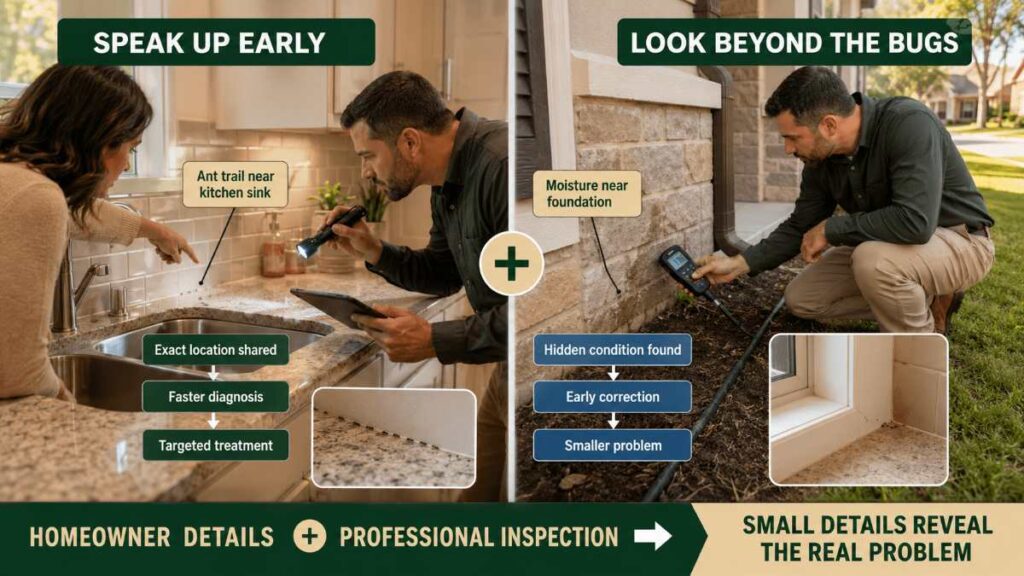
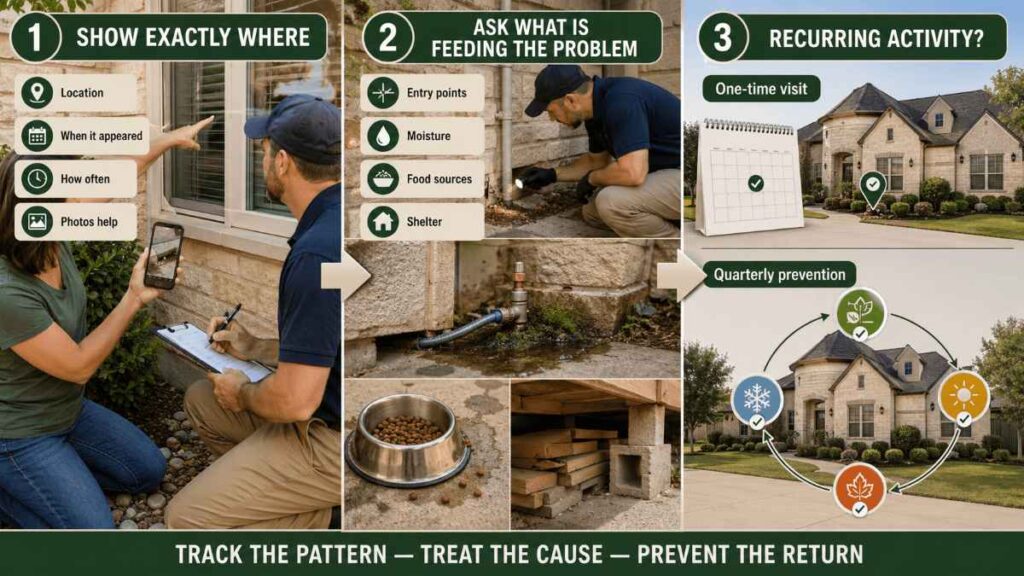
Consider a homeowner who mentions an ant trail near the kitchen sink right at the start of the visit. That one detail lets the technician zero in on exactly where treatment is needed instead of guessing at it. Or consider a different scenario: during a routine exterior check, a technician spots a small patch of moisture building up near the foundation, something the homeowner hadn’t connected to the occasional bugs they’d been seeing indoors. Catching that early heads off a much bigger problem down the road. These are the kinds of details a real inspection turns up, and they’re also a good reminder of how much a homeowner can help simply by speaking up.
Expert Tips
Point out specific problem areas instead of just saying you have bugs. The more detail a technician has to work with, the more targeted the treatment can be. Ask questions during the visit, especially about what conditions might be feeding the problem, since a good technician would rather explain than rush off to the next job. If you’re dealing with something recurring, ask about quarterly service instead of one-off visits. Ongoing prevention tends to outperform occasional treatment by a wide margin, especially here, where pest pressure never really takes a break.
Conclusion
A pest control visit doesn’t have to be a mystery. Done right, it starts with a conversation, includes a licensed technician’s full inspection, and ends with a clear explanation of what was found and treated. That’s the standard Texas Beeline holds every visit to, whether it’s a first appointment or a routine follow-up. If you’re ready to see that process for yourself, reach out to Texas Beeline and schedule a visit.
Avoid Costly Pest Control Mistakes!
Don’t let DIY errors cost you more in the long run! Beeline Pest Control of Texas provides expert inspections and science-based solutions to correct common pest control mistakes to avoid. Protect your San Antonio home with a customized plan that gets rid of pests for good!
No Hidden Charges
Frequently Asked Questions
Do I need to leave my house during pest control treatment?
Usually not, though your technician may recommend staying out of specific treated areas for a short time. They will let you know exactly what applies to your visit.
Is pest control safe for pets and kids?
Yes, when treatment is applied correctly and any recommended waiting time is followed. Your technician will explain any precautions specific to your home and the areas being treated.
How long until I can go back into treated areas?
This depends on the treatment used, but your technician will tell you exactly what to expect before they leave. When in doubt, just ask during the visit.
What should I do to prepare my home before the technician arrives?
Clear access to any problem areas you’ve noticed, secure pets somewhere comfortable, and make a note of any specific concerns so you remember to mention them.
Will the technician treat inside and outside my home?
In most cases, yes. A thorough visit typically includes an exterior perimeter check along with interior treatment focused on the areas that need it.
What if I still see bugs after the pest control visit?
Reach back out. Some problems take more than one visit to fully resolve, and follow-up is a normal part of the process, not a sign something went wrong.
How often should I schedule pest control service?
Many homeowners benefit from a quarterly schedule, since ongoing prevention tends to work better than occasional treatment, especially in a region with year-round pest activity like Texas.
Can I ask the technician questions during the visit?
Absolutely. A good technician will walk you through what they are finding and doing, and welcomes questions about your specific situation.
Are pest control technicians licensed and trained?
Yes, technicians arrive in uniform, carry identification, and are licensed and trained to handle the pests common to this region.
What happens if I'm not satisfied with the pest control results?
Reach out and let the company know. Addressing concerns directly, rather than waiting, is the fastest way to get a follow-up visit scheduled and the issue resolved.