
Fire Ants in Texas: What Every Homeowner Needs to Know
Keypoints:
- Fire ant mounds are loose, dome-shaped, and have no visible entry hole, unlike most other ant mounds.
- Mounds often seem to appear overnight after rain, but the colony was likely there all along, just deeper underground.
- A fire ant sting is not a single bite. It is a bite that anchors the ant, followed by repeated stings in a circular pattern.
- Treating the mound you can see rarely solves the problem, since colonies split and relocate when disturbed.
- DIY methods can knock back a single mound, but lasting control usually means treating the colony, not just the surface.
Introduction
You are walking barefoot across the backyard, and there it is: a raw mound of dirt that definitely was not there yesterday.
If you have spent even one summer in Texas, you already know what that means. Fire ants do not announce themselves quietly. They show up fast, defend their turf without hesitation, and turn one careless step into an afternoon you would rather forget.
This guide covers what every Texas homeowner should know: how to tell a fire ant mound from any other kind, why they seem to spring up overnight, what really happens when one stings you, and, maybe most importantly, what it takes to get rid of fire ants in Texas for good instead of just knocking back the mound you can see today.
How to Identify Fire Ants and Their Mounds
Start with the ants themselves. In Texas, the culprit behind most infestations is the red imported fire ant, known scientifically as Solenopsis invicta.
Here’s what to look for:
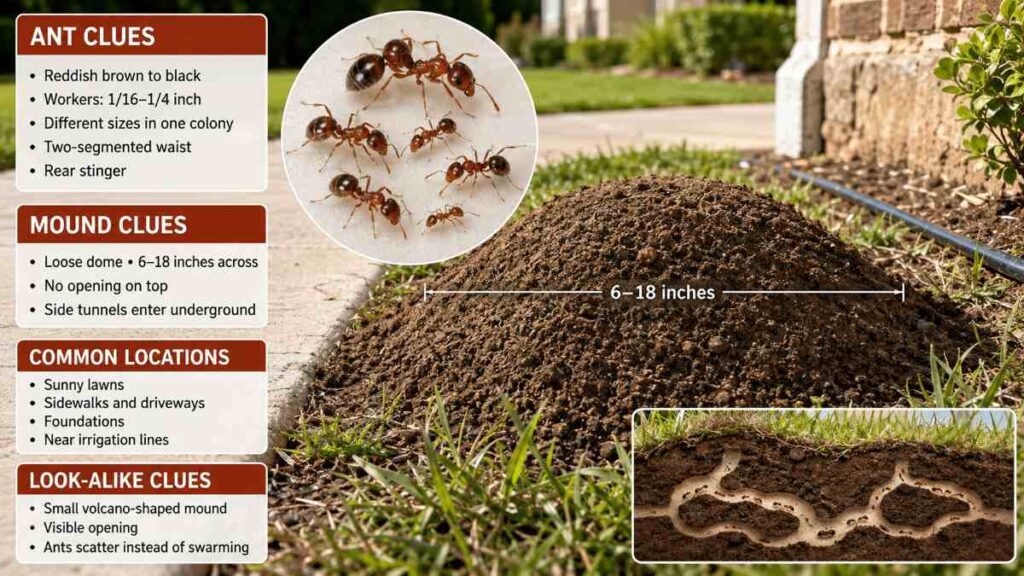
- Color: reddish brown to black
- Size: workers range from about one sixteenth of an inch to a full quarter inch, all within the same colony
- Build: a two-segmented waist and a stinger at the rear, which most nuisance ants around Texas homes do not have
- Mound: loose, dome-shaped, 6 to 18 inches across, with no obvious hole on top
- Location: open, sunny spots such as lawns, sidewalks, driveways, foundations, and areas near irrigation lines
The mound is usually the giveaway before you get anywhere near the ants. Fire ants tunnel in from the sides underground, so a mound with no visible opening is one of the clearest signs you’re looking at.
If instead you see a small volcano-shaped mound with a visible opening, or the ants scatter rather than swarm when disturbed, you’re probably dealing with sugar ants or pavement ants. Neither defends a mound the way fire ants do.
Once you can tell fire ants apart from these look-alikes, the next question is usually why the mounds keep showing up in the first place.
Why Fire Ant Mounds Seem to Appear Overnight
Where did this come from? It wasn’t here yesterday. That’s the question almost every homeowner asks eventually.
The honest answer is a little anticlimactic: the colony was almost certainly already there, just sitting deeper in the soil where you couldn’t see it.
Fire ants retreat further underground during hot, dry stretches, then push back up toward the surface once rain softens the ground. That’s the whole mystery behind mounds “appearing overnight” after a Texas thunderstorm. A yard in San Antonio can go from mound-free to three fresh mounds within a day or two, not because new colonies moved in, but because the ones already there simply resurfaced.
New construction doesn’t offer much protection either. Recently disturbed soil is easy for a colony to move through and settle in, which is why newer subdivisions in Cibolo and Schertz often see fire ant activity within months of a house being finished, sometimes before the sod has fully taken root.
Texas A&M AgriLife Extension research estimates that fire ants cost Texans hundreds of millions of dollars each year in yard damage, medical costs, and control efforts. This is less a backyard nuisance than a genuine statewide problem.
Understanding why mounds show up is only half the picture. The other half is understanding just how much that first sting can affect you.

Are Fire Ants Dangerous? Sting Symptoms and Treatment
Yes, fire ants are genuinely something to take seriously, though the goal here is caution, not alarm.
What makes a fire ant sting different is the mechanics behind it. The ant bites first to anchor itself, then stings repeatedly in a tight circular pattern. That’s why an encounter often leaves behind a telltale ring of small, raised bumps instead of a single mark.
Most people get off relatively easily: localized pain, itching, and small pustules that form within about a day. Leave them alone rather than popping them, since that’s when infection risk goes up. A cold compress and an over-the-counter antihistamine usually take care of the rest.
A smaller number of people have a stronger reaction, including true allergic responses, and multiple stings at once raise the stakes no matter your history.
If you’re stung, here’s what to do:
- Move away from the area first. Swatting at the ants can trigger more stings.
- Clean the sting site.
- Resist the urge to pop any pustules that form.
- Use a cold compress or antihistamine for the itching.
- Get medical attention right away for trouble breathing, swelling well beyond the sting site, or dizziness. Do not wait these out.
Children and pets face the same risk, often more so, since both tend to investigate a mound before anyone can stop them. A curious dog or a barefoot kid running through the yard is usually how a fire ant encounter happens in the first place, which is exactly why knowing what a mound looks like matters as much for prevention as it does for treatment.

Why Fire Ants Keep Coming Back
If you’ve treated a mound before and watched the problem return a few weeks later, you haven’t done anything wrong. You’ve simply run into how these colonies behave.
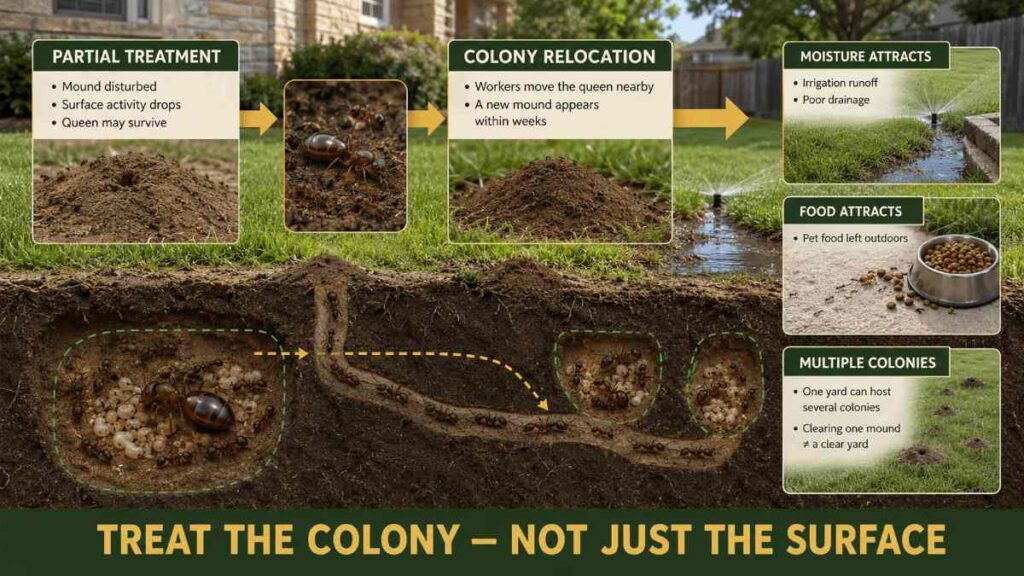
Disturb or partially treat a mound, and rather than dying off, the colony often splits, with workers relocating the queen somewhere nearby. That’s why a treated yard can sometimes look worse afterward instead of better.
Moisture and food make things worse:
- Irrigation runoff and poor drainage attract colonies looking to relocate
- Pet food left outside overnight does the same
- A single yard can easily host several independent colonies at once, so clearing one mound doesn’t mean the yard is clear. It means one colony, out of possibly several, is gone.
This pattern, treating the surface while the problem turns up again close by, is the whole reason DIY fire ant control has a reputation for falling short. It’s worth looking at what actually happens when you try to handle it yourself, and where that approach tends to run into trouble.
Getting Rid of Fire Ants: DIY vs Professional Treatment
DIY fire ant control isn’t a waste of time, but it helps to be honest about its limits.
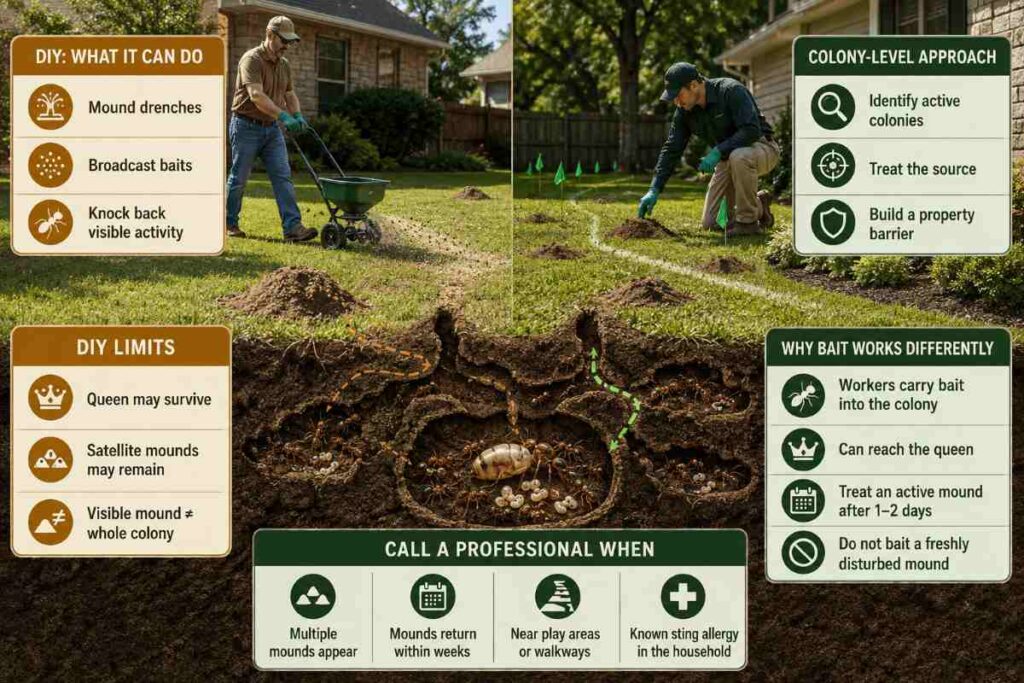
Mound drenches, boiling water, and broadcast baits can all knock back a mound you can see. Home remedies like grits or diatomaceous earth have their defenders too. The problem is that most of these treat the surface, not the colony underneath it, so the queen and any satellite mounds nearby usually go untouched.
Bait products work differently. Foraging worker ants carry the bait back into the mound and feed it to the queen and the rest of the colony, so a well-timed application can eliminate the source of the problem rather than just the ants on top. In practice, getting that timing right and choosing a bait the colony will actually forage on is harder than it sounds.
A tip straight from the field: treat a mound that’s been active for a day or two, rather than one that was just disturbed. That gives bait a much better shot at reaching the colony, since the ants are foraging normally instead of hunkered down in defense mode.
Professional treatment starts to make more sense once:
- Mounds show up in multiple spots
- They keep returning within weeks of DIY treatment
- They turn up somewhere with real foot traffic, like a play area or walkway
- Anyone in the house has a known sting allergy
At Texas Beeline, the professional pest exterminators treat fire ants as a colony problem, not a surface problem, identifying active colonies and building a treated barrier around the property rather than only spraying whatever happens to be visible that day. Customers who have used the service consistently mention the same thing: technicians who take the time to explain what they’re doing and follow through instead of rushing to the next stop. That matters as much as the treatment itself when it’s your yard and your family.
How to Prevent Fire Ants From Coming Back
Long-term control has less to do with any single treatment and more to do with prevention. A few things help:
- Fixing irrigation or drainage issues that leave standing water
- Keeping pet food indoors
- Maintaining a treated barrier around the home
Each one removes a reason for a new colony to settle there. Fire ants are persistent and mobile enough that most Texas homeowners find a proactive quarterly treatment schedule works far better than waiting for the next mound to show up. That’s the idea behind Texas Beeline’s Quarterly Maintenance Program, which treats fire ants alongside the other pests that come with living in Texas, rather than treating each new mound as a separate emergency.

Conclusion
Fire ants in Texas aren’t going anywhere. They’re as much a fixture of the state as the heat that brings them out every summer.
But a mound in the yard doesn’t have to mean months of stings and repeat treatments. Once you know what you’re looking at, why it showed up in the first place, and what it actually takes to treat the colony instead of just the surface, you’re in a much stronger position, whether you handle it yourself or decide it’s time to call in help.
If fire ants have taken over part of your yard, or keep coming back no matter what you try, Texas Beeline can take a look and treat the colony itself, not just the mound on top. Call or request a quote today to get started.
Avoid Costly Pest Control Mistakes!
Don’t let DIY errors cost you more in the long run! Beeline Pest Control of Texas provides expert inspections and science-based solutions to correct common pest control mistakes to avoid. Protect your San Antonio home with a customized plan that gets rid of pests for good!
No Hidden Charges
Frequently Asked Questions
How do I know if it's a fire ant mound and not just an anthill?
Look for a loose, dome-shaped pile of soil with no visible opening on top, usually 6 to 18 inches wide. Most other ants build smaller mounds with a clear entry hole, or skip the visible mound altogether.
Do fire ants die off in the winter?
Not exactly. They go dormant instead, retreating deeper underground once it gets cold. As soon as temperatures climb back up, the colony typically becomes active again, so a quiet winter doesn’t mean it’s gone for good.
Can fire ants damage my house?
Not structurally. Unlike termites, they don’t feed on wood, so think of them as a yard and outdoor safety issue rather than a threat to your home’s foundation or framing.
Why did a mound show up right after it rained?
Rain pushes fire ants closer to the surface, which makes mounds that were already there suddenly visible. It’s less a case of a new colony moving in and more a case of an existing one resurfacing.
Do fire ants bite, sting, or both?
Both, in a specific order. A fire ant bites to anchor itself, then stings repeatedly from that same spot in a circular pattern, which is why an encounter often leaves a distinctive ring of small welts instead of one isolated mark.
What's the best home remedy for fire ants?
Boiling water and mound drenches can kill part of a visible mound, but they rarely reach the queen or any satellite colonies nearby. Most home remedies offer short-term relief rather than a lasting fix.
How many fire ant colonies can be in one yard?
More than most homeowners expect. A single yard can easily host several independent colonies at the same time, so clearing one mound only takes care of that one colony, not the others nearby.
Are fire ants unique to Texas?
No, but Texas’s warm climate and soil conditions make them especially common and active for most of the year. Other southern states deal with fire ants too, just rarely with the same persistence.
When should I actually worry about a fire ant sting?
Most stings cause nothing more than local pain, itching, and pustules that clear up on their own. Seek medical attention if someone has trouble breathing, swelling well beyond the sting site, dizziness, or has taken a large number of stings at once.
How often should a yard be treated to keep fire ants away?
Most Texas homeowners get better results from a proactive quarterly treatment schedule than from one-time spot treatments. Consistent treatment catches new colonies before they ever become a mound you notice.