
The Truth About Texas Centipede Bites: Identification, Venom, and Expert Protection
Keypoints:
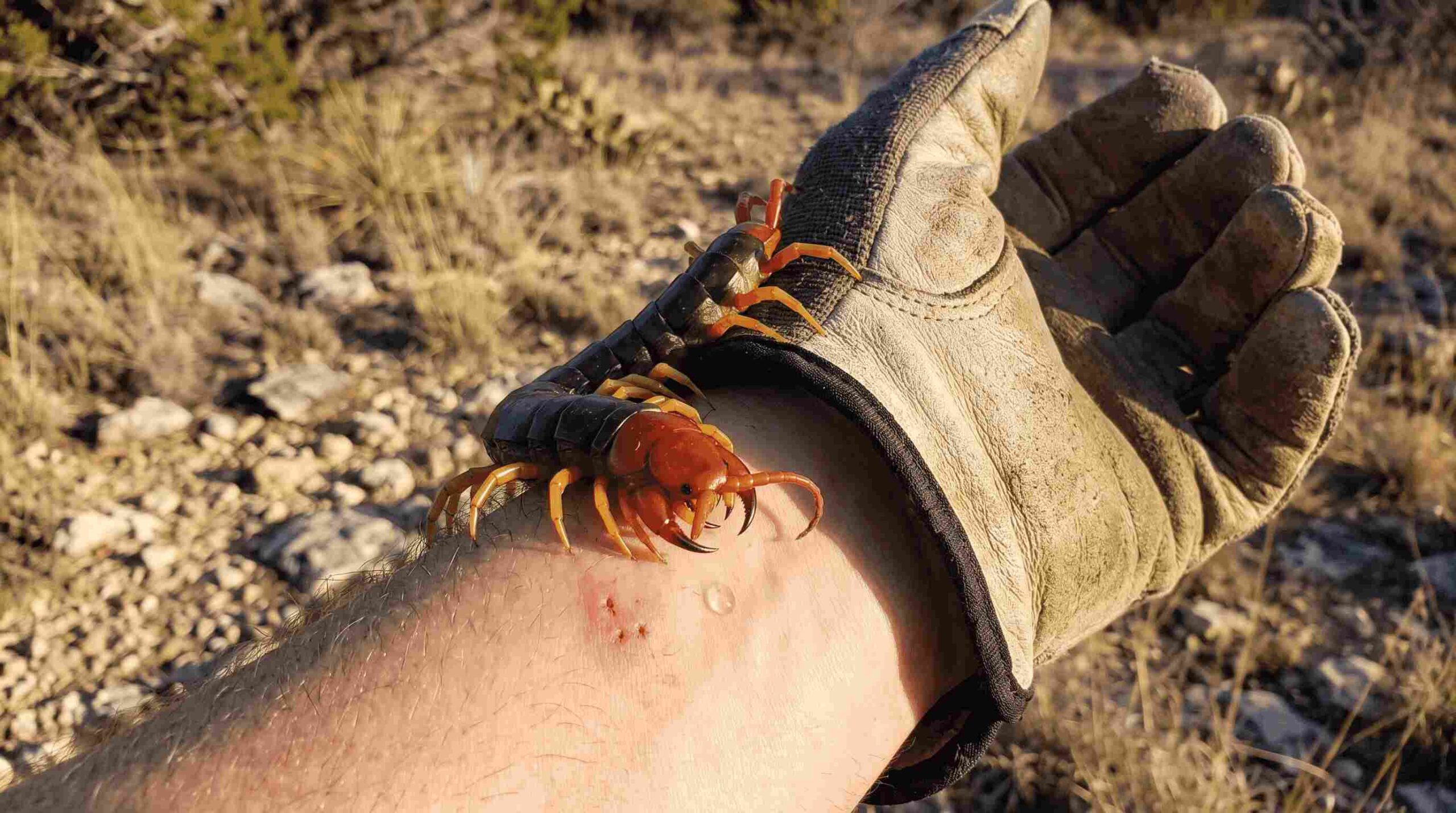
- The Bite vs. Sting Reality: Centipedes don’t actually bite with teeth; they pinch and inject venom using specialized front legs called forcipules.
- Varying Risks: Common house centipedes are mostly harmless to humans, but larger species like the Texas Redheaded Centipede can deliver a highly painful sting.
- Climate Drivers: Intense Texas heat and sudden downpours force these moisture-loving pests into slab foundations, weep holes, and commercial properties.
- Professional Defense: DIY treatments rarely reach centipede nesting zones; a professional quarterly pest management program is the best way to secure your property.
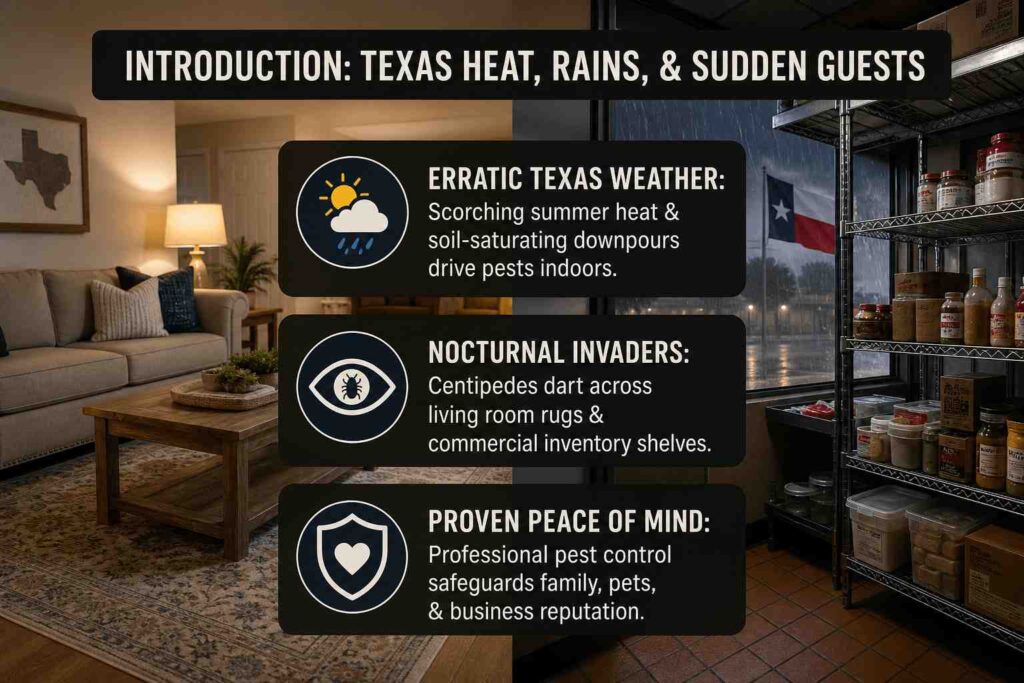
Owning property in the Lone Star State comes with plenty of pride and its fair share of unique pest challenges. When scorching summer temperatures hit San Antonio or sudden, heavy downpours saturate the soil, local wildlife starts looking for an escape route. More often than not, that route leads straight into your home or commercial facility.
Among the most unsettling nocturnal invaders property owners encounter are centipedes. Darting across a living room rug or slipping under a restaurant inventory shelf, their erratic movement and multi-legged silhouettes are enough to make anyone jump. But beyond the initial scare, a pressing question naturally arises: Are these leggy intruders actually dangerous to my family, pets, or customers?
Understanding the real risks of centipede venom and knowing when to call for professional pest control services that Texas property owners trust is essential for maintaining peace of mind and protecting your property’s reputation.
The Biology of the Beast: Why Texas is Scorpion Country
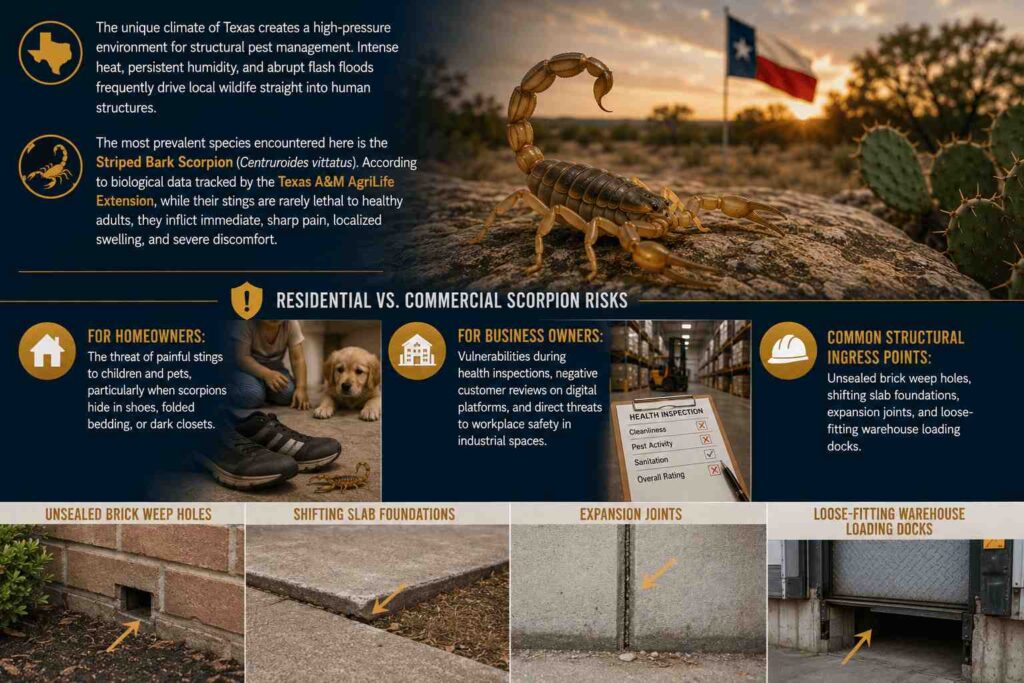
The unique climate of Texas creates a high-pressure environment for structural pest management. Intense heat, persistent humidity, and abrupt flash floods frequently drive local wildlife straight into human structures. The most prevalent species encountered here is the Striped Bark Scorpion (Centruroides vittatus). According to biological data tracked by the Texas A&M AgriLife Extension, while their stings are rarely lethal to healthy adults, they inflict immediate, sharp pain, localized swelling, and severe discomfort.
Residential vs. Commercial Scorpion Risks
- For Homeowners: The threat of painful stings to children and pets, particularly when scorpions hide in shoes, folded bedding, or dark closets.
- For Business Owners: Vulnerabilities during health inspections, negative customer reviews on digital platforms, and direct threats to workplace safety in industrial spaces.
- Common Structural Ingress Points: Unsealed brick weep holes, shifting slab foundations, expansion joints, and loose-fitting warehouse loading docks.
Understanding the Threat: Why Centipedes Venture Indoors
Centipedes are predatory arthropods that rely heavily on high-moisture environments to survive. In the wild, they thrive under damp leaf litter, rotting logs, and loose rocks. However, the erratic Texas climate frequently disrupts these natural habitats. Prolonged droughts dry out their outdoor hiding spots, while heavy rains flood them. To survive, centipedes seek out humid, sheltered indoor environments.
Homeowner Risks vs. Business Pitfalls
- For Homeowners: Centipedes frequently exploit architectural vulnerabilities like unsealed weep holes, expansion joints, and cracks in slab foundations. Once inside, they gravitate toward crawl spaces, basements, bathrooms, and laundry rooms, causing significant stress for families and pets.
- For Business Owners: The stakes are even higher. Centipedes often find their way into commercial loading docks, damp janitorial closets, and warehouse inventory areas. While they do not spread diseases like roaches or rodents, their intimidating appearance can severely damage a business’s reputation. A single centipede sighting in a retail space or restaurant dining room can trigger negative online reviews or even regulatory scrutiny during a health inspection.
Why Rain Drives Them In: Centipedes lack a waxy cuticle on their exoskeletons, meaning they dry out rapidly in the Texas heat. When heavy rains saturate the soil, it forces them out of their flooded underground tunnels directly into your dry slab foundation.
The Anatomy of a Bite: How Texas Centipedes Attack
To understand the immediate risk a centipede poses, we have to look closely at its anatomy. Many property owners ask whether centipedes bite or sting. Technically, they do neither in the traditional sense. Centipedes do not possess stinging tails like scorpions, nor do they use mouthparts to bite like spiders or ants.
Instead, they attack using their first pair of walking legs, which have evolved into sharp, curved claws called forcipules. Located just beneath the head, these specialized appendages pinch the flesh and inject venom into their prey. Because this action functions exactly like a venomous bite, most people refer to it as a centipede bite or sting.
The V-Shaped Mark: Because centipedes inject venom using a twin pair of curved claws rather than a single stinger or chewing mandibles, their marks usually present as two distinct puncture wounds forming a V-shape or chevron pattern on the skin.
While small house centipedes lack the physical strength to pierce human skin, larger outdoor species, such as the formidable Texas Redheaded Centipede (Scolopendra heros), can easily break the skin. According to entomological data tracked by the Texas A&M AgriLife Extension Service, these giants can grow up to 8 or 9 inches long and possess 23 pairs of legs, making their envenomation highly painful.
Why DIY Centipede Control Falls Short
When property owners notice an influx of centipedes, the common knee-jerk reaction is to grab a canister of over-the-counter bug spray. Unfortunately, self-treatment rarely solves the problem.
- Hidden Structural Nests: Centipedes are solitary, fast-moving hunters that hide deep within structural voids. Spraying visible pests does nothing to eliminate the hidden population.
- Endless Prey Supply: Centipedes are strictly carnivorous; they enter your property because there is an abundant food source of other insects, such as spiders, roaches, or silverfish.
- Chemical Repellency Issues: Standard retail sprays often cause pests to scatter deeper into wall voids rather than eradicating the root colony.
The professional solution offered by Texas Beeline focuses on an integrated approach. We don’t just treat the centipedes; we identify and eliminate their food sources, seal their entry points, and apply targeted treatments to the damp structural zones where they breed, ensuring long-term protection for homes and commercial establishments alike.
The Importance of Year-Round Quarterly Pest Management
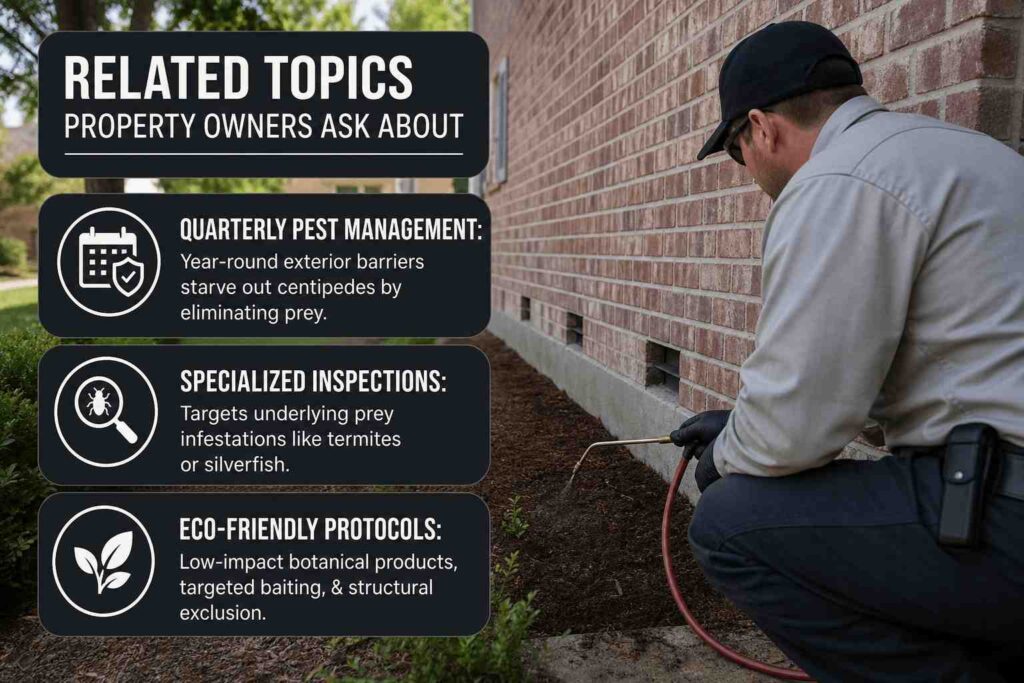
Centipedes are highly resilient, meaning a one-time emergency treatment will only provide temporary relief. Enrolling in a regular quarterly pest management program is the single most effective way to keep centipedes out. By establishing a consistent exterior protective barrier around your home or business, professional technicians can stop pests before they ever step foot inside. Regular treatments break the reproductive cycles of smaller target insects, effectively starving out predatory centipedes.
General vs. Specialized Services
While a general pest control plan addresses common invaders like ants, roaches, and silverfish, specialized services may be required for deep-seated infestations. For instance, if centipedes are thriving because your home has an undetected subterranean termite issue that provides an endless food supply, a specialized inspection is crucial to protecting your property’s structural integrity.
What is Eco-Friendly Pest Control?
Modern property owners want pest solutions that don’t compromise environmental health or indoor air quality. True eco-friendly pest control prioritizes targeted baiting, structural exclusion, and low-impact botanical or mineral-based products. This approach focuses heavily on altering the environment reducing moisture and sealing entryways rather than relying solely on heavy chemical applications.
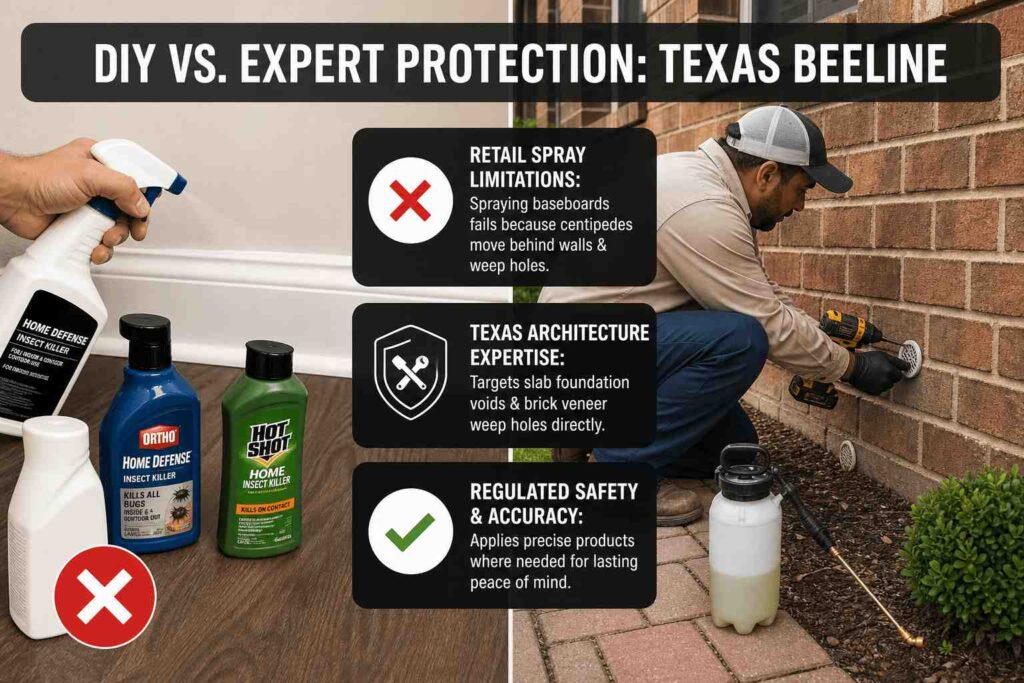
Trying to handle a centipede issue on your own can quickly turn into an expensive game of whack-a-mole. It often involves applying unnecessary amounts of chemicals in the wrong places, which can pose risks to children, pets, and commercial customers.
Expert Insight from the Field:
“Many homeowners we visit have applied retail dusts and sprays all over their baseboards, yet the centipedes keep coming. That’s because the pests are traveling behind the walls and through the weep holes. True eradication requires knowing the specific entry points of local Texas architecture and treating those hidden pathways directly.”
– Licensed Technician, Texas Beeline
Professional pest control means relying on experts who understand Texas-specific construction vulnerabilities, like slab foundations and brick veneer weep holes. Texas Beeline utilizes advanced application methods that keep safety at the forefront, using strictly regulated products precisely where they are needed. This guarantees peace of mind and long-term results that a retail spray bottle simply cannot deliver.
Texas Beeline Property Protection Plans
Every property requires a distinct defensive strategy. Texas Beeline offers flexible, customized programs tailored to your specific environment.
- Quarterly Maintenance Program: Our premier year-round shield. We perform thorough exterior inspections and barrier treatments every three months, adjusting our approach to match changing seasonal pest pressures in Texas.
- Specialized Services: Focused, high-impact protocols targeting highly destructive or challenging pests, including comprehensive Termite treatments, Rodent exclusion, Bed Bug remediation, and Commercial compliance programs.
- Free Property Inspection: Every successful defense starts with an accurate assessment. We offer comprehensive, obligation-free inspections to pinpoint exactly where pests are entering and thriving on your property.
Whether you need residential care or robust commercial pest control Texas business owners lean on, our services are fully optimized for San Antonio and its surrounding communities.

At Texas Beeline, safety is our absolute priority. We utilize eco-friendly, EPA-approved products and targeted application methods designed to eliminate pests while remaining entirely safe for children, domestic pets, and sensitive commercial environments like restaurant dining rooms and food storage warehouses.
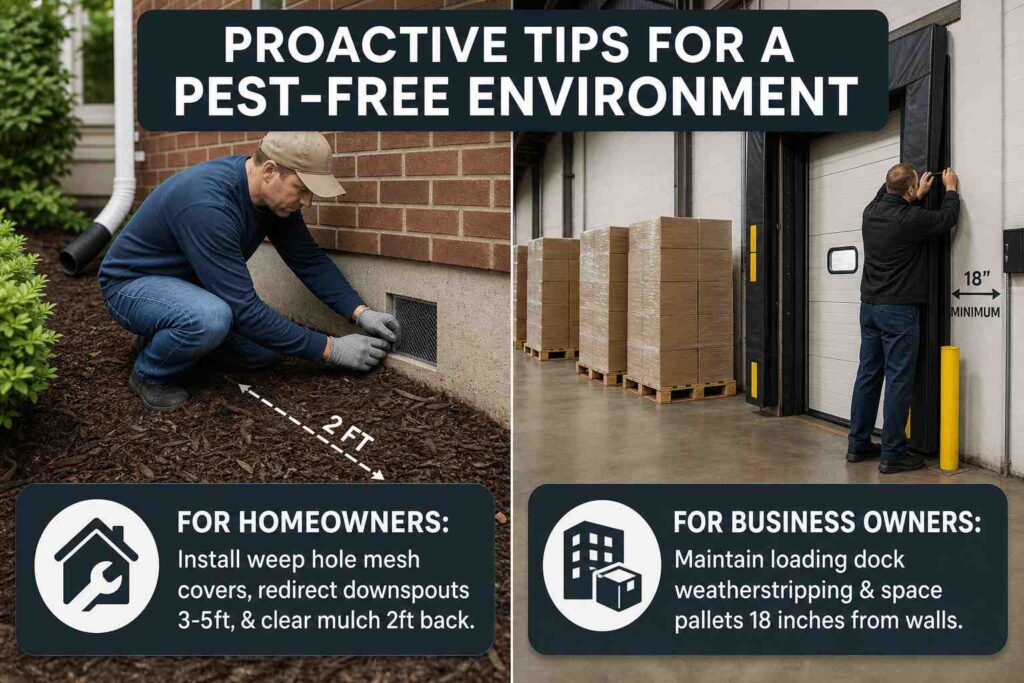
While professional treatments form your primary shield, practicing good property maintenance drastically reduces pest pressure.
For Residential Homeowners:
- Install Weep Hole Covers: Use specialized mesh covers that allow your brick walls to vent moisture without letting centipedes or scorpions crawl inside.
- Redirect Downspouts: Ensure all gutters and splash blocks funnel rainwater at least three to five feet away from your home’s slab foundation.
- Clear Perimeter Mulch: Keep organic mulch, dead leaves, and firewood piles pulled back at least two feet from the exterior walls.
For Commercial Business Owners:
- Maintain Loading Docks: Inspect rubber dock seals frequently and replace any worn weatherstripping immediately to eliminate ground-level gaps.
- Optimize Waste Management: Ensure commercial dumpster pads stay completely clear of debris, and keep container lids tightly closed at all times.
- Implement Pallet Spacing: Store warehouse inventory on pallets spaced at least 18 inches away from interior walls to eliminate dark, damp runway zones for pests.
Property Maintenance Tip: Never store firewood or raw lumber directly against a building exterior, as this acts as an immediate structural breeding ground for large centipedes and termites.
Conclusion: Protect Your Texas Property Today
Centipedes may be a natural part of the diverse Texas ecosystem, but they have no place in your home or business. Attempting to deal with these venomous, fast-moving pests on your own often leads to frustration, wasted money, and unresolved underlying pest issues. Investing in local, professional protection is the most reliable way to secure your structure, safeguard your family’s comfort, and preserve your commercial compliance.
Don’t let pests take over. Call Texas Beeline today for expert pest control! We provide pest control services in San Antonio, Universal City, Converse, Castle Hills, Alamo Heights, Cibolo, and other areas in Texas. To find out more about our residential pest control services and commercial pest control services, click the links, visit our Contact Us page and fill out our form, or call us at 210-739-1320 to schedule your free inspection.
Avoid Costly Pest Control Mistakes!
Don’t let DIY errors cost you more in the long run! Beeline Pest Control of Texas provides expert inspections and science-based solutions to correct common pest control mistakes to avoid. Protect your San Antonio home with a customized plan that gets rid of pests for good!
No Hidden Charges
Frequently Asked Questions
Do centipedes attack humans?
No, centipedes do not actively hunt or attack humans. They are reclusive creatures that only lash out as a defensive reflex if they are accidentally stepped on, squeezed, or handled. If you are noticing frequent centipede activity, calling Texas Beeline can safely resolve the problem.
Do centipedes bite humans?
Yes, larger species of centipedes can bite humans if they feel threatened or trapped against skin. While their “bite” is actually a pinch from modified legs, it can pierce the skin and introduce venom. Professional treatments from Texas Beeline can keep these dangerous encounters away from your living spaces.
Do centipedes bite or sting?
Centipedes technically do both simultaneously; they use sharp, modified front legs called forcipules to pinch (bite) the skin and immediately inject venom (sting). For the average property owner, the experience feels identical to an intense insect sting. Contacting Texas Beeline helps ensure your property is protected from these painful pests.
Do centipedes bite?
Yes, centipedes possess the ability to bite when cornered or disturbed. If you spot one on your property, it is best to avoid touching it and contact Texas Beeline for professional removal. Our team has the specialized equipment to handle infestations safely.
Do centipedes have stingers?
No, centipedes do not have stingers located on their tails as scorpions do. Instead, their venom-delivery apparatus is located right underneath their head, modified from their first pair of legs. Texas Beeline can implement specialized treatment barriers to stop them from entering your structures.
Do centipedes hurt you?
A house centipede bite rarely causes much pain, but a sting from a larger Texas specimen can be intensely painful, causing localized swelling and redness. If you are experiencing centipede issues, reaching out to Texas Beeline can ensure your environment remains safe and comfortable. Our regular maintenance plans prevent infestations before they start.
Do centipedes kill you?
No, centipede stings are not fatal to humans, though they can cause significant discomfort and localized swelling. According to historical tracking by the Centers for Disease Control and Prevention (CDC), severe systemic reactions are incredibly rare unless an individual has a specific, severe allergic reaction to the venom. To lower the risk of encounters entirely, trust Texas Beeline to manage your perimeter defense.
Do centipedes sting or bite?
They utilize modified front claws to puncture the skin and inject venom, which combines elements of both actions. Regardless of the terminology, a professional treatment program from Texas Beeline can prevent these painful encounters entirely. We address the root causes of their presence.
Do centipedes sting?
Yes, through their venom-injecting claws, centipedes can deliver a painful sting to protect themselves. Keeping your property free of their preferred insect prey with help from Texas Beeline is the best way to avoid a sting. Our treatments eliminate their natural food supply.
Do house centipedes bite humans?
It is extremely rare for a common house centipede to bite a human because their front claws are typically too small and weak to break human skin. However, their presence usually points to an underlying insect problem that requires professional attention. Texas Beeline can perform a thorough inspection to trace the source.
Do house centipedes bite?
House centipedes can technically bite their small insect prey, but they pose virtually no physical bite threat to humans or larger domestic pets. If you see them frequently, contact Texas Beeline to evaluate your property for other hidden pests. We offer custom plans to manage all crawling insects.
Do house centipedes have venom?
Yes, house centipedes possess venom, which they use exclusively to paralyze small insects like silverfish and spiders. This venom is not dangerous to humans and is rarely successfully injected into human skin. Let Texas Beeline clean up your indoor environment so these predators have no reason to stay.
Do house centipedes sting?
They do not possess the structural capability to sting humans effectively. To eliminate the unsettling sight of house centipedes darting across your floors, consider establishing a quarterly pest management plan with Texas Beeline. We ensure your interior spaces remain completely pest-free.
How does a centipede bite?
A centipede bites by wrapping its pair of curved, hollow front legs around an object, piercing the surface, and pumping venom directly into the wound from internal glands. If you want to keep these predatory pests outside where they belong, reaching out to Texas Beeline is your best course of action.
What do centipede bites look like?
A centipede bite typically presents as two small puncture marks forming a V-shape, surrounded by a red, swollen localized skin reaction. The appearance closely resembles a mild bee sting or spider bite. To avoid dealing with mysterious bites on your property, let Texas Beeline establish an exterior barrier.
What do house centipede bites look like?
Because house centipedes rarely successfully break human skin, a bite from one usually leaves no visible mark at all, or at most, a very minor, temporary red spot. If you notice larger, painful marks, you may be dealing with an outdoor centipede species or a different pest entirely. Texas Beeline can help accurately identify and eradicate the true culprit.
What happens if I get stung by a centipede?
If stung by a large centipede, you will likely experience immediate, burning pain, swelling, and redness around the puncture site. These localized symptoms generally subside within a few hours to less than 48 hours. Texas Beeline can help safeguard your home so you never have to experience this pain firsthand.
What neutralizes centipede venom?
Applying a comfortably warm compress or soaking the area in warm water can help break down the heat-labile protein toxins in centipede venom, while antihistamines reduce discomfort. For a long-term solution to prevent these pests from entering your home, trust the experts at Texas Beeline. Our treatments resolve the issues permanently.
Will a centipede bite me while I sleep?
It is highly unlikely, as centipedes actively avoid human contact; however, an accidental bite can occur if a roaming centipede gets trapped beneath your body or blankets while you turn over. Enrolling in regular pest control services Texas experts recommend from Texas Beeline is the best way to rest easy at night. Our proactive defenses keep your bedrooms completely clear.