
German vs. American Cockroach: Which One Is in Your Texas Home?
Key Points
- Size is the fastest tell: German cockroaches are 1/2 to 5/8 inch long; American cockroaches are 1 1/2 to 2 inches.
- German roaches don’t live outdoors in Texas, so one in the kitchen usually means a colony is already inside.
- American roaches live mostly outdoors and in sewers and come in through drains and door gaps.
- The species decides the fix: indoor baiting for German roaches, exterior treatment and sealing for American roaches.
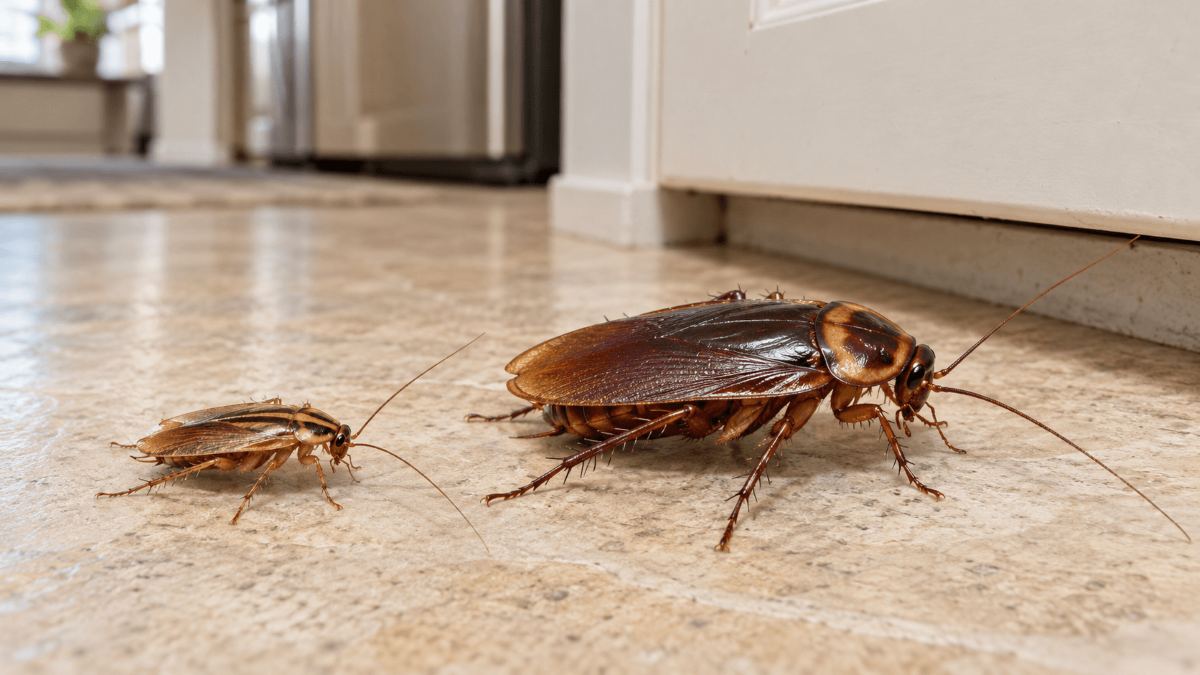
If the roach you just saw was small, light brown, and had two dark stripes behind its head, it’s a German cockroach. If it was big, reddish-brown, and about as long as your thumb, it’s almost certainly an American cockroach.
Getting the German vs. American cockroach question right matters, because German roaches breed inside your kitchen while American roaches are mostly outdoor bugs that wandered in.
Here’s how to tell them apart, plus what Beeline Pest Control sees on cockroach control jobs around San Antonio.
German vs. American Cockroach: How Do You Tell Them Apart?
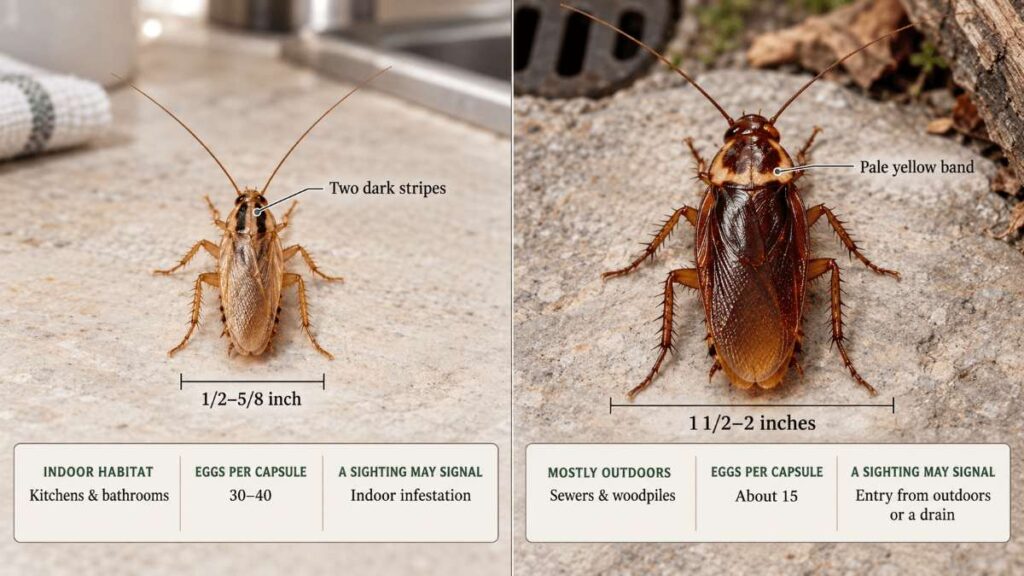
The quickest German vs. American cockroach test is size and markings. German cockroaches are 1/2 to 5/8 inch long and light brown, with two dark stripes on the shield behind the head. American cockroaches are 1 1/2 to 2 inches long and reddish brown, with a pale yellow band around that shield.
| Feature | German cockroach | American cockroach |
| Size | 1/2 to 5/8 inch | 1 1/2 to 2 inches (the largest roach in Texas) |
| Color and markings | Light brown, two dark stripes behind the head | Reddish brown, light yellow band around the shield behind the head |
| Flight | Has wings but doesn’t fly | Can glide short distances |
| Where it lives | Indoors only in Texas | Mostly outdoors: sewers, woodpiles, palm trees |
| Eggs per capsule | 30 to 40 | About 15 |
| Egg capsule | Female carries it for up to a month | Female leaves it near where she’s living |
| Time to adulthood | About 2 to 3 months | 470 to 600 days |
| What a sighting usually means | An active indoor infestation | Often a visitor from outside or a drain |
Sources: Texas A&M AgriLife Cockroach Biology and Management and the Field Guide to Common Texas Insects (German, American).
Quick coin check: a German cockroach is shorter than a penny is wide (3/4 inch). An adult American cockroach is about as long as two quarters laid side by side.
What Does a German Cockroach Look Like?
German cockroaches are small and light brown, with two dark parallel stripes on the shield just behind the head. They have full wings but don’t fly, and don’t live outdoors in Texas.
Breeding is what makes them hard to beat: the female carries a capsule of 30 to 40 eggs on her body for up to a month, out of reach of sprays and cleaning. German cockroach is one of the most widespread public health pests in urban homes, apartments, and restaurants.
Signs You Have German Cockroaches
- Droppings like ground black pepper along cabinet hinges, drawer corners, and behind the fridge
- Brown, bean-shaped egg capsules in cracks near the kitchen or bathroom
- A musty, oily smell inside cabinets
- Roaches out in daylight, which points to a heavy population
What Does an American Cockroach Look Like? Is It a Palmetto Bug?
An American cockroach is the largest roach in Texas: 1 1/2 to 2 inches long and reddish-brown, with a light yellow band around the shield behind its head. “Palmetto bug” and “waterbug” are Southern nicknames for big roaches like this one.
It is mostly an outdoor insect living in woodpiles, palm trees, and sewer systems. Adults can glide, which is why one sometimes sails off a wall toward you on a summer night.
They catch newcomers off guard. One customer new to Texas wrote in a review that they weren’t ready for “the size of the cockroaches.”
Baby Roaches: The Mix-Up That Fools Most Homeowners
Most German vs. American cockroach mix-ups happen with babies. Many people who think they have German cockroaches are actually looking at young American roaches. Small, wingless, and brown, they pass for German adults at a glance.
Check the back. German nymphs are dark, with a pale stripe running down the middle, according to the Texas A&M field guide. Young American roaches are a plain grayish to reddish brown with no stripes.
Expert tip: Set a sticky trap overnight where you saw the roach. A trapped roach is far easier to check against the table than one sprinting under the stove. Texas A&M recommends them for monitoring, not control.
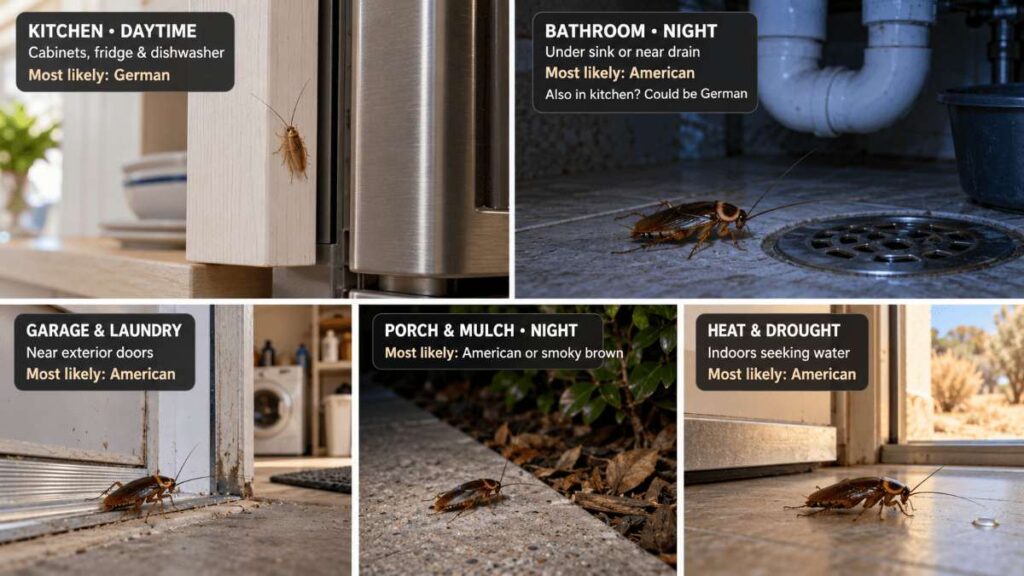
Where You Saw It Tells You Almost as Much as What It Looks Like
| Where and when you saw it | Most likely |
| Kitchen cabinets, behind the fridge or dishwasher, especially in daytime | German |
| Under the bathroom sink or near a floor drain at night | American (German if you’re also seeing them in the kitchen) |
| Garage, laundry room, or near an exterior door | American |
| Porch, mulch beds, or eaves after dark | American or smoky brown |
| Indoors during a long hot, dry stretch | American, looking for water |
That last row is common in South Texas summers. Texas A&M AgriLife entomologists note that pests move indoors during heat and drought, looking for water and cooler air.
Other Texas Roaches You Might Be Looking At
- Smokybrown: 1 1/4 to 1 1/2 inches, dark brown to black. Common in mulch, palm fronds, and attic eaves in humid parts of Texas.
- Oriental: about 1 1/4 inches, dark brown to black, flightless. Prefers cool, damp, ground-level spots like crawl spaces.
- Turkestan: males are brownish yellow and 1/2 to 7/8 inch long. Increasingly common in western Texas, often in compost and potted plants.
Which Is Worse, German or American Cockroaches?
German cockroaches are the bigger problem for most homes. They breed indoors, multiply fast, and are linked to allergies and asthma; the EPA lists cockroaches among common asthma triggers.
American cockroaches haven’t been shown to directly carry disease, but they can contaminate food and kitchen utensils. A steady stream of them inside means something is letting them in.
Why the Species Changes the Treatment
This is where the German vs. American cockroach difference matters most, because the two need almost opposite approaches:
- German cockroaches: treat inside, where they live. Pea-sized dabs of gel bait in the cracks where they hide do most of the work. Texas A&M says foggers don’t reach those cracks, and that sprays or dusts near baits make roaches avoid the bait.
- American cockroaches: focus outside and at entry points. An exterior perimeter treatment and clearing woodpiles and leaf litter cut down the population around the house. Sealing is homeowner or handyman work: check threshold seals under doors, screen soffit vents, and keep water in drain traps, all steps Texas A&M recommends.
German infestations rarely clear in one visit because nymphs keep hatching from protected capsules; one Beeline customer with German roaches summed up the result as “after 3 sprays, NONE.” See how exterminators get rid of cockroaches and our Texas cockroach prevention guide.
When Should You Call a Professional?
You don’t always need one. A single American cockroach in the garage usually calls for sealing gaps and setting a few sticky traps to see if more show up. Our guide on how to get rid of roaches covers low-risk first steps.
Call a professional if you:
- See any German cockroach indoors
- See roaches during the day
- Find droppings or egg capsules in cabinets or drawers
- Keep finding American roaches inside week after week
When a Beeline technician comes out, they inspect, identify the species, build the treatment around it, and explain what they found (here’s what happens during a pest control visit). For ongoing protection, our residential pest control service covers both interior and exterior treatments.
Know Your Roach, Then Match the Fix
Here’s the German vs. American cockroach difference in two lines. Small, striped, and in the kitchen means German cockroaches and an indoor baiting plan. Big, reddish, and near a drain or door usually means American cockroaches, an exterior treatment, and a little sealing on your end.
Not sure which one you have? Request a free quote, call 210-739-1320, or text a clear photo to 210-972-1672, and we’ll tell you what you’re looking at.
Avoid Costly Pest Control Mistakes!
Don’t let DIY errors cost you more in the long run! Beeline Pest Control of Texas provides expert inspections and science-based solutions to correct common pest control mistakes to avoid. Protect your San Antonio home with a customized plan that gets rid of pests for good!
No Hidden Charges
Frequently Asked Questions
German vs. American cockroach: which one is worse?
Yes, for most homes. German cockroaches live and breed indoors and multiply quickly, while American cockroaches usually wander in from outside.
Can German cockroaches fly?
No. German cockroaches have full wings but run rather than fly. American cockroaches can glide short distances from a wall or other high surface.
Is a palmetto bug the same as an American cockroach?
Often, yes. “Palmetto bug” is a Southern nickname for large outdoor roaches, most often American or smoky brown cockroaches.
Does seeing one German cockroach mean I have an infestation?
Usually. One can hitchhike in on a grocery bag or box, but German roaches don’t live outdoors in Texas, so one inside typically means more are hiding nearby.
What do baby German cockroaches look like?
They’re small, wingless, and dark, with a pale stripe down the middle of the back. As they mature, they turn light brown and develop the two dark stripes behind the head.
Why am I seeing big roaches in my house when it's hot?
They’re usually American cockroaches looking for water and cooler air. Fix leaks, seal gaps around doors and pipes, and keep drain traps filled.
Do American cockroaches come up through drains?
Yes. They’re one of the most common roaches in sewer systems and use floor drains to get into buildings. Running water in rarely used drains every couple of weeks keeps their traps from drying out.
Will bug bombs get rid of German roaches?
No. Texas A&M notes that foggers don’t reach the cracks where most cockroaches hide, so most of the population survives. Gel baits placed close to hiding spots work far better.
Can you get German cockroaches in a clean house?
Yes. Cockroaches can ride in on grocery bags, boxes, or luggage, and in apartments they can move in from a neighboring unit.
How long does it take to get rid of German cockroaches?
It usually takes several visits over a few weeks, because eggs protected inside capsules keep hatching after the first treatment. Texas A&M suggests switching to a different bait if there’s no control within 2 to 3 weeks.