
Scorpions in Helotes and the Hill Country: Why They Get More
Key Points
- It’s almost always a striped bark scorpion. The sting hurts, but Texas A&M says no Texas scorpion is considered lethal.
- The land is the reason. Limestone, rock, and cedar woodland give scorpions ideal daytime cover.
- New homes on cleared land can see more scorpions because construction wipes out the habitat they live in.
- Your yard and roofline matter more than your zip code. Use the 10-point check below to rate your property.
Scorpions in Helotes, Boerne, and Vintage Oaks are more common than in central San Antonio because these neighborhoods sit on scorpion habitat. Scorpions live in the limestone, rock, and cedar the homes are built on, and they move indoors when it’s hot and dry.
One Helotes homeowner wrote in a review that they “always have an influx of scorpions and spiders that show up in the summer.” This article explains why that happens, how to tell if your home is a magnet, and which fixes are worth your time. For identification and treatment basics, see our scorpion control page.
Which Scorpion Are You Finding in Your Hill Country Home?
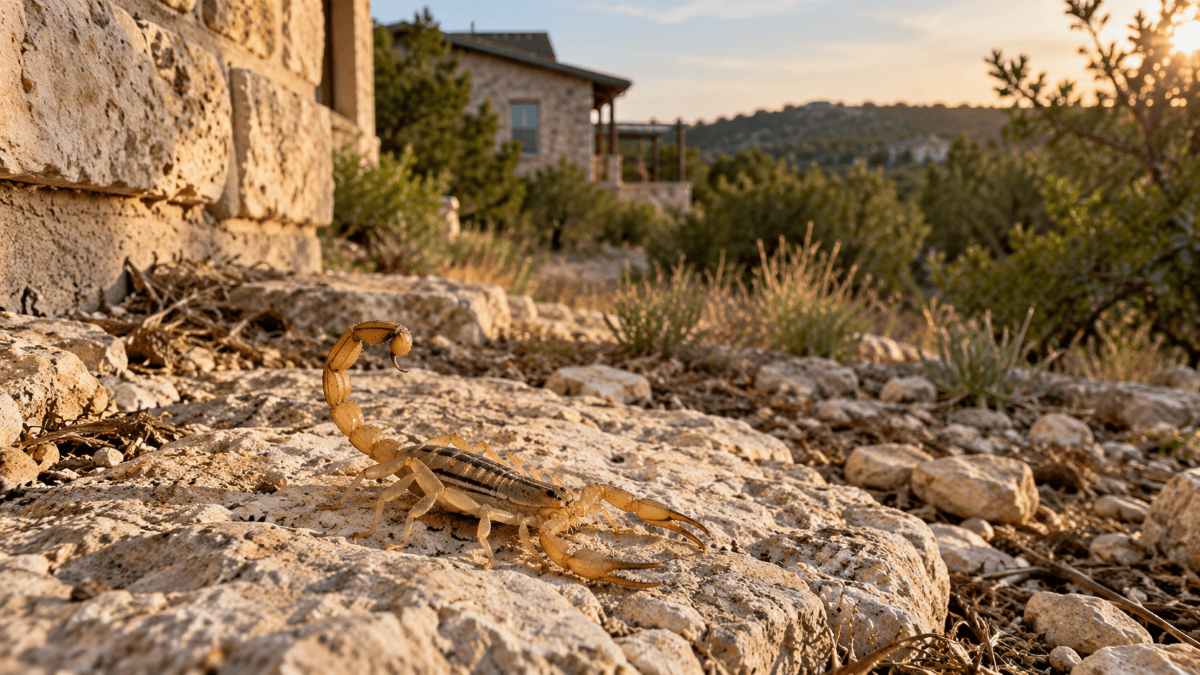
Nearly all scorpions in Helotes and Hill Country homes are striped bark scorpions. Adults are about 2 1/2 inches long and yellowish tan, with two broad dark stripes down the back, slender pincers, and a long, thin tail.
Texas has 18 scorpion species, but the striped bark scorpion is the only one found throughout the state, according to Texas A&M AgriLife. It’s a climber, which is why people find them on walls, ceilings, and in attics.
Why Are There So Many Scorpions in Helotes and the Hill Country?
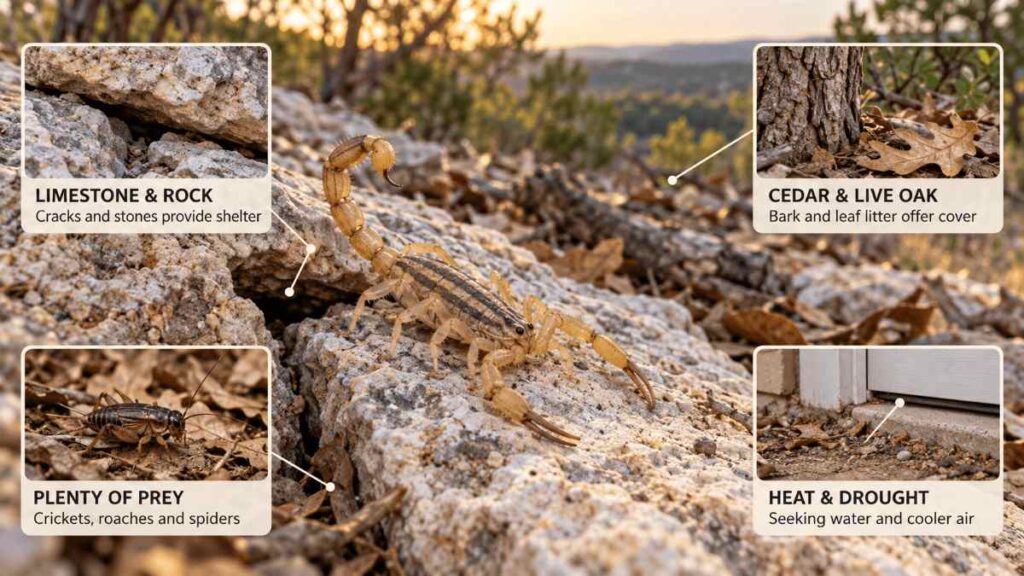
Hill Country terrain gives striped bark scorpions nearly everything they need: rock, cedar, and insects to eat.
Limestone and rock everywhere
The Texas Parks and Wildlife Department describes the Edwards Plateau as rolling limestone country with shallow soils. Texas A&M lists the striped bark scorpion’s habitat as rocky slopes and spaces under rocks, boards, and debris. As AgriLife entomologist Wizzie Brown explains, “Their bodies are flat, which allows them to hide in small cracks and under stones, bark, wood, or other objects.”
Cedar and live oak woodland
Ashe juniper, which locals call cedar, is the dominant tree across much of the region, alongside plateau live oak. The Texas A&M field guide names “juniper breaks” as scorpion habitat, and loose bark and leaf litter shelter the insects they hunt.
Plenty to eat
Scorpions eat insects, spiders, centipedes, and even other scorpions, so a yard full of crickets and roaches keeps them fed next to your walls.
Heat and drought
Hot, dry stretches send scorpions looking for water and cooler air. Bexar County AgriLife entomologist Molly Keck says that “when they feel that temperature difference below a door or by another small crack, they can squeeze their way inside.”
Why New Subdivisions Often Get More Scorpions
Oklahoma State University entomologists note that homes in new developments can see more scorpions because construction destroyed their natural habitat. When a lot is cleared of cedar and rock, the nearest shelter is often your foundation.
That pattern fits the newer neighborhoods carved out of brush around Helotes, Boerne, and the New Braunfels side of the Hill Country. One Vintage Oaks homeowner wrote in a review that they had a scorpion problem “as many do in Vintage Oaks.”
What to expect: a yearly pattern, not a one-time event, especially if your lot backs onto undeveloped land.
Is Your Home a Scorpion Magnet? A 10-Point Property Check
Score one point for each item that’s true of your home:
- Stone landscaping, rock borders, or a retaining wall touches the foundation
- Firewood is stacked against the house or garage
- Cedar or oak branches touch the roof or walls
- Brick or stone siding has open weep holes
- Exterior doors have visible gaps at the bottom
- An AC condenser or drip line keeps soil damp next to the slab
- Mulch or leaf litter is piled against the foundation
- Gaps at the eaves or roofline lead into the attic
- Porch lights draw bugs to your doorways at night
- Your lot backs onto brush, a greenbelt, or undeveloped land
How to read it: 0-3 is low risk. 4-6 means you’ll likely see scorpions every summer. 7-10 means your home offers shelter, moisture, and food in one place.
These risk factors flag debris, stones, and overhanging branches, and Oklahoma State, which flags weep holes and damp areas around AC units. The scoring bands are our own rule of thumb, not a scientific scale.
Where Scorpions Hide Inside Hill Country Homes
Inside, scorpions look for dark, sheltered spots. Texas A&M notes that striped bark scorpions are often found in attics, and they also turn up in bathrooms, under sinks, in closets, in garages, and in shoes left on the floor.
Expert tip: Shake out shoes and towels before using them, and keep beds a few inches from the wall with bedding off the floor. A bed against the wall is an easy climb.
How to Check for Scorpions at Night With a Blacklight
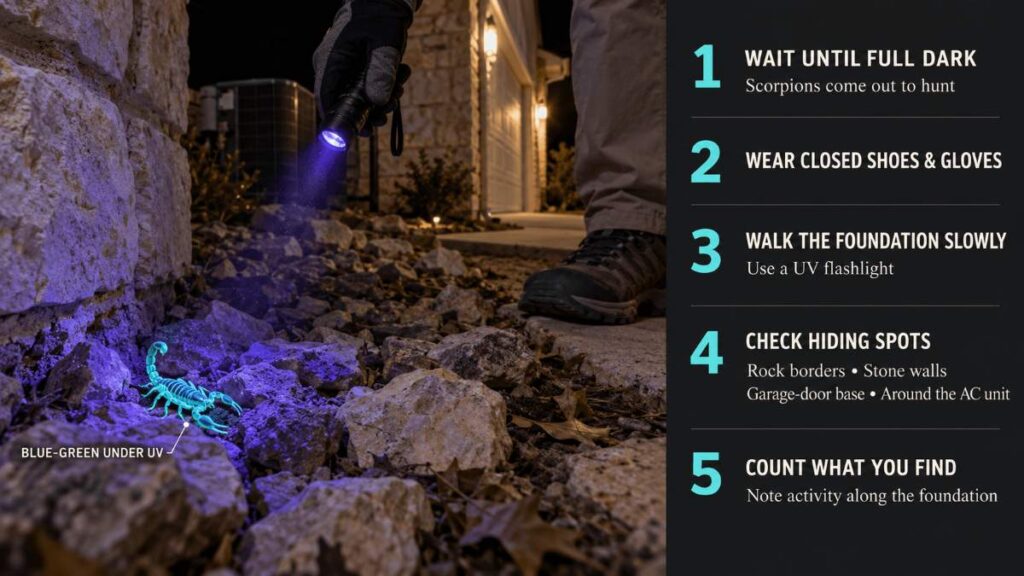
Scorpions glow blue-green under ultraviolet light, a trick AgriLife entomologists recommend for finding them.
- Wait until full dark, when scorpions come out to hunt.
- Wear closed shoes and gloves.
- Walk the foundation slowly with a UV flashlight.
- Check rock borders, stone walls, the base of the garage door, and around the AC unit.
- Count what you find. A handful along the foundation tells you far more than one in the hallway.
What to Do If You or Your Pet Gets Stung
For most people, a striped bark scorpion sting causes pain, swelling, and itching that can last several days, and Texas A&M says no Texas scorpion is considered lethal. An ice pack helps with pain. Watch the person for several hours, and get immediate medical attention if pain or swelling persists, hives appear, or breathing becomes difficult. Take extra care with young children and anyone with allergies.
For advice, call Poison Help at 1-800-222-1222, which connects Texas callers to the free, 24-hour Texas Poison Center Network. If a pet is stung, call your veterinarian.
This section is general information, not medical advice.
How Do You Keep Scorpions Out When You Live Next to Their Habitat?
You can’t change the terrain, but you can make your house the least inviting spot on the block. Three moves do most of the work:
- Seal the way in: weather-stripping, screened weep holes, and caulk around pipes and eaves.
- Remove cover touching the house: pull rock, firewood, and debris away from the foundation, and trim branches off the roof.
- Cut their food supply: fewer crickets, roaches, and spiders means fewer scorpions hunting near your walls.
Oklahoma State entomologists say it’s not practical to control scorpions with insecticides alone, and you may see more activity right after clearing their hiding spots. The best results come from treatment and habitat changes together. Beeline Pest Control handles the treatment side through our residential pest control service: a perimeter treatment around the foundation and entry points that also knocks down the insects scorpions feed on. Sealing is homeowner or handyman work, so ask your technician to show you the gaps they spot.
For step-by-step methods, see our guide to eliminating scorpions in Texas, our tips on how to get rid of scorpions in Texas, and these home remedies for scorpions.
It’s the Land, Not Your Housekeeping
Scorpions in Helotes, Boerne, and the newer subdivisions nearby come with the setting. The goal is keeping them outside: remove cover, seal gaps, and keep the bug population down.
If your property check came back high, or you’re finding scorpions indoors every week, Beeline can help. Request a free quote or call 210-739-1320.
Avoid Costly Pest Control Mistakes!
Don’t let DIY errors cost you more in the long run! Beeline Pest Control of Texas provides expert inspections and science-based solutions to correct common pest control mistakes to avoid. Protect your San Antonio home with a customized plan that gets rid of pests for good!
No Hidden Charges
Frequently Asked Questions
Why are there so many scorpions in Helotes and the Hill Country?
The region’s limestone, rock, and cedar woodland is ideal scorpion habitat. Scorpions hide under rocks and bark by day, and heat and drought push them toward homes for water and cooler air.
Are striped bark scorpions dangerous?
Their sting is painful but produces only moderate reactions in most people. Get medical care right away if pain or swelling persists, hives appear, or breathing becomes difficult.
Can a Texas scorpion sting kill you?
Texas A&M says no Texas scorpion is considered lethal. Young children and people allergic to the venom can react more strongly, so watch them closely after a sting.
Why am I finding scorpions in my new house?
Building on cleared land destroys scorpions’ natural hiding spots, so they move to the nearest shelter, often a new home’s foundation. Sealing gaps and clearing rock and debris near the house helps.
Do scorpions live in attics?
Yes. Striped bark scorpions climb well and are often found in attics, usually getting in through gaps at the eaves or via branches touching the roof.
When are scorpions in Helotes and Boerne at their worst?
Summer is usually worst, especially during hot, dry stretches when scorpions look for water indoors. Oklahoma State entomologists also note that late spring and early summer rains can send them looking for drier shelter.
Do blacklights really find scorpions?
Yes. Scorpions glow blue-green under ultraviolet light, so a nighttime walk around your foundation is an easy way to gauge how many you have.
Does cedar attract scorpions?
Cedar woodland is part of their natural habitat, and branches touching your roof give them a bridge to the attic. Trimming branches back from the house removes that route.
Will pest control get rid of scorpions completely?
When you live next to their habitat, the realistic goal is fewer scorpions, not zero. A quarterly perimeter treatment, combined with sealing and clearing cover around the house, keeps numbers down year-round.
Do scorpions live in nests?
No. Striped bark scorpions don’t build nests or dig burrows; they shelter under rocks, boards, bark, and debris. A female does carry her young, usually 13 to 47 of them, on her back for a short time after birth.