
Texas House Mice: Identification, Risks, and Control
Key Points
- House mice are gray all over, belly and tail included, with small eyes and ears.
- A brown mouse with a white belly and two-toned tail is a native deer or white-footed mouse, and it carries a different health risk.
- They multiply fast. Texas A&M AgriLife reports 24 mice producing 2,000 in eight months.
- Use snap traps along the walls, not glue traps, and clean droppings wet, never by sweeping or vacuuming.
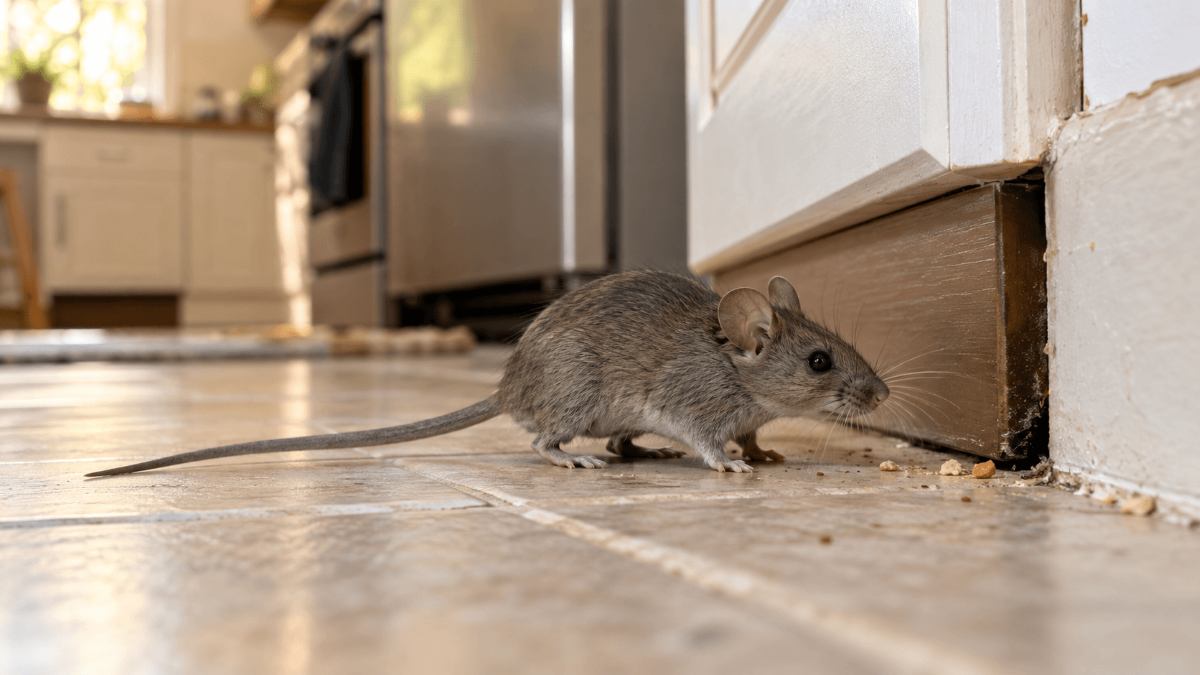
If you’ve found tiny dark droppings in a kitchen drawer or heard scratching in the wall at night, there’s a good chance you have house mice. House mice in Texas are small gray rodents that live alongside people, nest in warm spots close to food, and often move indoors when the weather cools.
Knowing which mouse you have matters. It tells you how fast the problem will grow, which health precautions to take, and how to get rid of them. For the bigger picture on rats and mice, see our rodent control page.
What Do House Mice in Texas Look Like?
A house mouse is small and uniformly gray or gray-brown, even the tail, with no sharp line between its back and belly, according to Wildlife Damage Management. Its eyes and ears are smaller than those of the native mice you might see outdoors.
You’ll often see their droppings before you see them. Texas A&M AgriLife describes house mouse droppings as 1/8 to 1/4 inch long and pointed, and a single mouse leaves 50 to 75 of them a day.
Expert tip: Droppings bigger than about 1/4 inch, or thick and blunt at the ends, usually point to rats instead.
House Mouse or Native Mouse? Why It Matters
Texas also has native mice, mainly deer mice and white-footed mice. They look different, and they bring a different health concern.
| House mouse | Deer mouse or white-footed mouse | |
| Color | Uniformly gray to gray-brown | Brown on top, white belly and feet |
| Tail | Same gray as the body | Sharply two-toned: dark on top, white below |
| Eyes and ears | Small | Larger |
| Where you find them | Inside and near homes | Grasslands, open brush, old cabins and outbuildings |
| Main health concern | LCMV (lymphocytic choriomeningitis virus) | Hantavirus (the deer mouse is the main U.S. carrier) |
Sources: Wildlife Damage Management, Texas Tech Mammals of Texas, CDC.
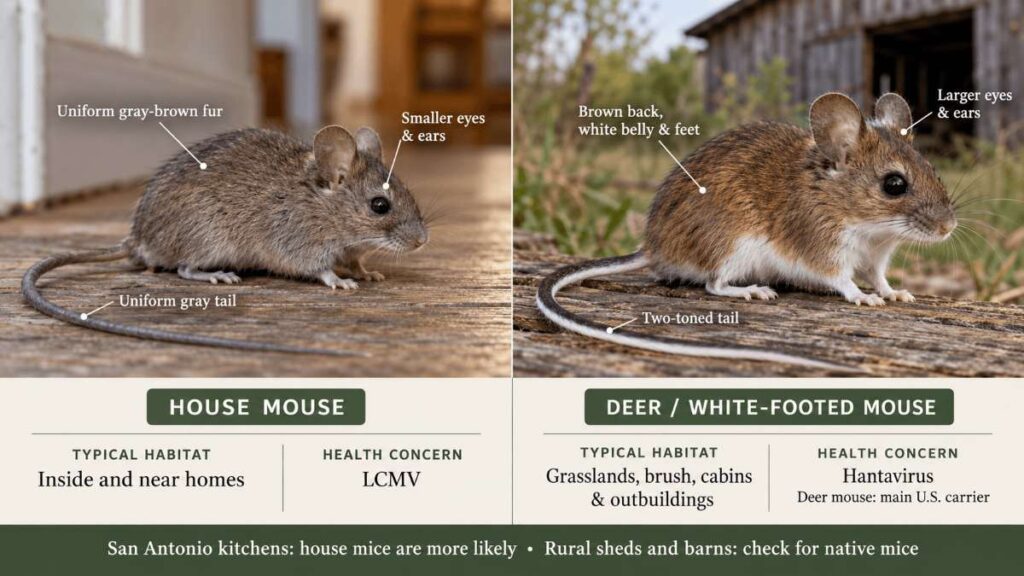
According to Texas Tech, deer mice live statewide but are uncommon in the eastern, coastal, and southern parts of Texas, and the hantavirus deaths it notes were mostly on the High Plains. In and around San Antonio, a mouse in the kitchen is far more likely to be a house mouse. Homes on rural lots with sheds or barns are the exception worth watching.
How Fast Do House Mice Multiply?
Faster than most people expect.
- Pregnancy lasts 18 to 21 days
- Young mice can breed at 6 to 10 weeks old
- A female has 6 to 10 litters of 5 to 6 babies each
That works out to 30 to 60 babies from one female, and her daughters start breeding within a couple of months. Texas A&M’s own example: 24 mice produced 2,000 mice in eight months. That’s why one mouse in the pantry is rarely the whole story.
Where Do House Mice Nest, and What Do They Eat?
House mice in Texas nest in warm areas close to food. Common spots include behind the stove and refrigerator, under the dishwasher, inside cabinet bases, in wall voids, and in cluttered garages. Texas A&M notes they’re active mostly at night, need very little water, and stay within about 20 to 50 feet of home.
That small range is why you’ll find chewed packaging in one part of the kitchen again and again. It also tells you where to put traps.
House mice often live outdoors in summer, then look for warm shelter near food as the weather changes. A mouse needs only a dime-sized hole or a 1/4-inch crack under a door to get in.
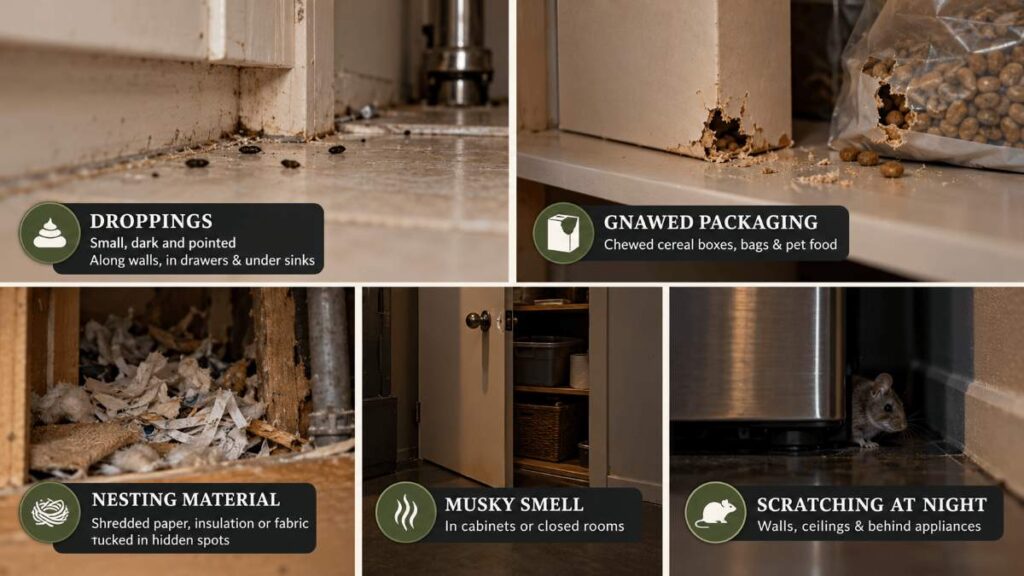
Signs You Have House Mice
- Droppings: small, dark, and pointed, along walls, in drawers, and under sinks
- Gnawed packaging: chewed corners on cereal boxes, bags, and pet food
- Nesting material: shredded paper, insulation, or fabric tucked in hidden spots
- A musky smell in cabinets or closed rooms
- Scratching at night in walls, ceilings, or behind appliances
Are House Mice Dangerous?
House mice can spread disease and contaminate food, but the specific risk is different from what many people assume.
- LCMV: The CDC says lymphocytic choriomeningitis is spread by the common house mouse. People catch it from fresh urine, droppings, saliva, or nesting material. It’s a particular concern during pregnancy, when a first-trimester infection can cause miscarriage, and later infections can cause serious birth defects.
- Hantavirus: The CDC says the most common hantavirus in the U.S. is spread by the deer mouse. House mice aren’t the main carrier, but the CDC’s cleanup precautions apply to any rodent droppings.
- Food contamination: Mice nibble through many packages, leaving droppings and urine behind.
This section is general information, not medical advice. If you’re pregnant or have a weakened immune system and have been exposed to mouse droppings, talk to your doctor.
How to Clean Up Mouse Droppings Safely
Never sweep or vacuum mouse droppings. The CDC warns against it because it can stir virus particles into the air. Instead:
-
- Open doors and windows for 30 minutes before you start.
- Wear rubber or plastic gloves.
- Spray droppings and urine with 1 part bleach to 9 parts water (or an EPA-registered disinfectant) until very wet.
- Let it soak for 5 minutes.
- Wipe up with paper towels and throw them in a covered trash can.
- Bag any dead mice, nesting material, and used traps.
- Wash your hands with soap and warm water after removing your gloves.
How to Get Rid of House Mice
Trap the mice you have
The CDC recommends snap traps baited with a pea-sized amount of chunky peanut butter. Set the baited end against the wall so the trap forms a “T,” in closed areas like behind the stove and refrigerator and in the backs of cabinets.
- Use several traps near each problem spot. With a 20- to 50-foot range, a trap across the house may never get visited.
- Skip glue traps and live traps. The CDC warns they can scare rodents into urinating, which raises your exposure risk.
Close the way in
Trapping without sealing just makes room for the next mouse. The CDC suggests filling small holes with steel wool held in place with caulk. Bigger gaps at the roofline or around utility lines are a job for a handyman.
When to call a professional
Call in help if you’re seeing droppings in more than one room, hearing activity in the attic or walls, or still catching mice after a couple of weeks. Beeline Pest Control handles the treatment side through our residential pest control service. We don’t do the sealing ourselves, but our technicians can point out likely entry points for you or your handyman to close. For typical pricing, see our mice pest control cost guide.
Get Rid of House Mice Before They Multiply
Gray all over usually means house mice; brown with a white belly means native mice and extra care during cleanup. With house mice in Texas, the fix is the same either way: snap traps along the walls, wet cleanup, and closing the gaps they use.
If the problem is bigger than a few traps can handle, Beeline can help with mouse control in San Antonio and the surrounding area. Request a free quote, call 210-739-1320, or text 210-972-1672.
Avoid Costly Pest Control Mistakes!
Don’t let DIY errors cost you more in the long run! Beeline Pest Control of Texas provides expert inspections and science-based solutions to correct common pest control mistakes to avoid. Protect your San Antonio home with a customized plan that gets rid of pests for good!
No Hidden Charges
Frequently Asked Questions
How do I identify house mice in Texas?
House mice are small and uniformly gray to gray-brown, including the belly and tail. They have smaller eyes and ears than native deer mice and white-footed mice, which are brown with white bellies.
Do house mice carry hantavirus?
House mice are not the main carrier. The CDC says the most common U.S. hantavirus is spread by the deer mouse, but you should still clean up any rodent droppings with the CDC’s wet method.
What is the difference between a house mouse and a deer mouse?
House mice are gray all over. Deer mice are brown on top with a white belly, white feet, a sharply two-toned tail, and larger eyes and ears.
How fast do house mice reproduce?
Pregnancy lasts about three weeks, and young mice can breed at 6 to 10 weeks old. Texas A&M AgriLife reports 24 mice producing 2,000 in eight months.
If I see one mouse, are there more?
Usually, yes. Mice breed quickly and stay within 20 to 50 feet of their nest, so one sighting often means a nest nearby.
What do mouse droppings look like?
House mouse droppings are small, dark, and pointed, about 1/8 to 1/4 inch long. You’ll usually find them along walls, in drawers, and under sinks.
What is the best bait for mouse traps?
The CDC recommends a pea-sized amount of chunky peanut butter on a snap trap. Set the baited end against the wall where you’ve seen droppings.
Are glue traps a good way to catch mice?
No. The CDC advises against glue traps and live traps because they can scare rodents into urinating, which increases your exposure risk.
How small a gap can a mouse get through?
Texas A&M says a mouse needs only a dime-sized hole or a 1/4-inch crack beneath a door. Seal openings larger than 1/4 inch to keep them out.
Is it safe to vacuum mouse droppings?
No. Vacuuming or sweeping can put virus particles into the air. Spray droppings with a bleach solution, let them soak for 5 minutes, and wipe them up with paper towels.